
BSL vs American Sign Language – Key Differences

British Sign Language vs American Sign Language is a fascinating comparison that reveals how sign languages develop independently of spoken languages. Despite both the UK and US using English, BSL and ASL are entirely separate languages with different alphabets, vocabularies, and grammar systems. Understanding these differences helps dispel the widespread misconception that sign language is universal.
Alphabet Differences
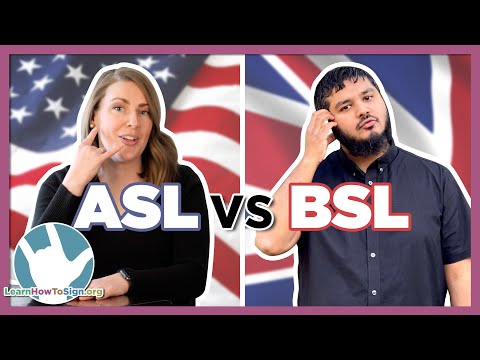
The most striking visual difference is the manual alphabet. BSL uses two hands to form letters, with both hands working together in specific configurations for each letter. ASL uses just one hand, with the dominant hand forming each letter independently. This means BSL fingerspelling involves two-handed coordination while ASL relies on single-hand dexterity.
BSL’s two-handed alphabet creates letter shapes that are often visual representations of the written letter. The letter C, for example, uses a curved hand shape that resembles a written C. ASL’s one-handed letters use different conventions, with some based on written forms and others on hand positions that don’t obviously resemble their letters.
Reading fingerspelling differs between the languages. BSL fingerspelling is generally considered easier to read because the two-handed shapes are larger and more visually distinct. ASL fingerspelling can be very fast and compact, making receptive fingerspelling one of the more challenging skills for ASL learners to develop.
Both alphabets are used for the same purposes — spelling proper names, technical terms, and words without established signs. However, ASL uses fingerspelling more frequently in conversation than BSL does. Some commonly fingerspelled words in ASL have no BSL equivalent because BSL tends to have established signs for concepts that ASL might fingerspell.
Vocabulary and Sign Comparisons
The signs for everyday concepts are completely different between BSL and ASL. The BSL sign for thank you bears no resemblance to the ASL version. The sign for mother, father, house, food, and hundreds of other common words are entirely distinct in each language.
Research estimates that BSL and ASL share less than 30 percent of their vocabulary. This level of overlap is no greater than what you’d find between any two unrelated languages. The signs that do appear similar between BSL and ASL are often coincidental rather than evidence of shared heritage.
Interestingly, ASL shares more vocabulary with French Sign Language (LSF) than with BSL. This reflects ASL’s historical origins — it developed from a mixture of LSF and native American signs when Laurent Clerc brought French signing methods to America in the early 19th century.
Regional variations within each language add another layer of complexity. BSL has different signs for the same concept in different parts of the UK, and ASL similarly has regional variations across the United States. This means there isn’t even a single “correct” version of BSL or ASL for every concept.
Practice Makes Perfect
Test your sign language skills with our free practice app.
Grammar and Sentence Structure
Both BSL and ASL have grammar systems independent of English, but their grammatical structures differ from each other. BSL typically favours a topic-comment structure where the topic of the sentence comes first, followed by what you want to say about it. ASL tends toward subject-verb-object order, though both languages are flexible.
Non-manual features serve grammatical functions in both languages but operate differently. The specific eyebrow positions, mouth patterns, and head movements that mark questions, negation, and emphasis differ between BSL and ASL. A BSL user’s grammatical facial expressions would look unfamiliar to an ASL user.
Both languages use the space in front of the signer for grammatical purposes, but the conventions differ. How you set up spatial references, use classifiers to describe movement and position, and establish pronominal reference points follow different rules in each language.
Temporal marking — how you express when something happened — works differently in BSL and ASL. Both languages use time signs and spatial positioning to establish timeframes, but the specific mechanisms and conventions vary. Learning one language’s temporal grammar doesn’t directly transfer to the other.
Why BSL and ASL Are So Different
Sign languages evolve within Deaf communities, not from the spoken languages around them. BSL developed among British Deaf communities over centuries, shaped by Deaf schools, Deaf clubs, and social networks unique to the UK. ASL developed among American Deaf communities with significant input from French Sign Language through historical connections.
The two languages belong to different sign language families. BSL is part of the BANZSL family, which includes Australian Sign Language (Auslan) and New Zealand Sign Language (NZSL). These languages share vocabulary and grammar because of historical connections between British, Australian, and New Zealand Deaf communities. ASL belongs to the French Sign Language family.
This family grouping means BSL users find Auslan and NZSL partially comprehensible, while ASL users find LSF partially comprehensible. But BSL and ASL remain as different from each other as any two unrelated spoken languages — sharing a spoken language has no bearing on sign language relatedness.
The diversity of sign languages worldwide reflects the natural process of language evolution. There are over 300 distinct sign languages globally, each developed by its own Deaf community. BSL and ASL are just two examples of this rich linguistic diversity that challenges the common assumption of sign language universality.
Related Articles
Practice ASL Signs
Use your camera to practice signs and get real-time AI feedback on your technique.
Free · No signup required