
British Sign Language vs ASL – Differences Explained

British Sign Language vs ASL is a question asked by many people who assume that English-speaking countries share the same sign language. In reality, BSL and ASL are completely different languages with distinct vocabularies, grammars, and histories. This concise guide highlights the main differences so you can understand why these two sign languages are not interchangeable.
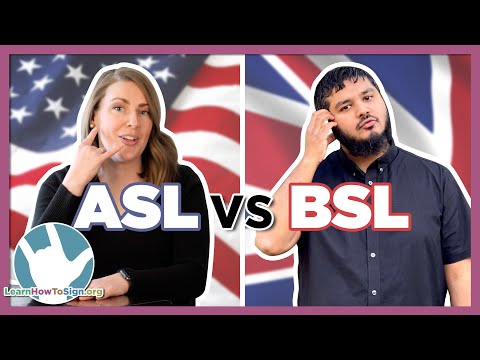
BSL vs ASL at a Glance
The manual alphabet is the clearest visible difference. BSL uses two hands to form letters, while ASL uses one hand. This means fingerspelling your name looks entirely different in each language. BSL’s two-handed system creates larger, more visually distinct letter shapes, while ASL’s one-handed alphabet is more compact and faster.
Vocabulary overlap between BSL and ASL is estimated at less than 30 percent. Signs for basic concepts like hello, goodbye, thank you, eat, drink, and family are completely different. There is no systematic relationship between BSL and ASL signs for the same concept.
BSL belongs to the BANZSL language family, sharing roots with Australian and New Zealand sign languages. ASL belongs to the French Sign Language family. This means a BSL user would actually find Australian Sign Language more familiar than ASL, despite the geographical distance.
Both languages have their own grammar systems that differ from English and from each other. Non-manual features, spatial grammar, and sentence structure follow different conventions in BSL and ASL, making them genuinely distinct linguistic systems.
Why BSL and ASL Developed Differently
Sign languages evolve within Deaf communities independently of the spoken languages around them. BSL grew organically among British Deaf people through centuries of community interaction. Its development was shaped by British Deaf schools, Deaf clubs, and the social networks of the UK’s Deaf population.
ASL has roots in French Sign Language. When Laurent Clerc, a Deaf French teacher, came to America in 1817 to help establish Deaf education, he brought French signing with him. ASL developed from the merger of these French signs with existing American Deaf community signs, giving it a fundamentally different heritage from BSL.
This explains the counterintuitive fact that ASL is more closely related to French Sign Language than to BSL. Linguistic heritage in sign languages follows community contact patterns, not spoken language boundaries. The British and French Deaf communities had different community networks, leading to different sign language families.
Both BSL and ASL continue to evolve today. New signs emerge for modern concepts, regional variations develop and spread, and contact between Deaf communities influences language change. Each language remains a living, dynamic system shaped by its users.
Practice Makes Perfect
Test your sign language skills with our free practice app.
Communication Between BSL and ASL Users
When BSL and ASL users meet, they cannot communicate directly through their respective sign languages. The differences are too significant for mutual comprehension. However, Deaf people from different countries have developed strategies for cross-linguistic communication.
International Sign (IS) is a contact variety of signing used at international Deaf events, conferences, and gatherings. It draws on gestures, shared sign features, and adaptable communication strategies to enable understanding between signers of different languages. IS is not a standardised language but a pragmatic communication tool.
Many Deaf people who travel or have international contacts learn elements of other sign languages. Some BSL users learn basic ASL for travel or online communication with American Deaf friends. This bilingualism is common among internationally connected Deaf people.
Technology has increased contact between BSL and ASL communities. Social media connects Deaf people worldwide, and platforms like YouTube and TikTok feature content in both languages. This exposure means many young Deaf people recognise signs from other languages even if they don’t use them fluently.
Which Language to Learn
Choose based on geography and community. If you live in the UK, learn BSL. If you live in the US or Canada, learn ASL. The practical value of a sign language comes from being able to communicate with the Deaf community around you, so location should drive your decision.
If you’re learning for a specific relationship — a Deaf colleague, friend, or family member — learn whatever sign language they use. Don’t assume a Deaf person in the UK uses BSL or a Deaf person in the US uses ASL without checking. Individual Deaf people may use different sign languages depending on their background.
ASL has more online learning resources due to the larger US market, but BSL resources are growing rapidly. Both languages have accredited qualification pathways, online courses, and community practice opportunities. The quality of learning available for both BSL and ASL is excellent.
Skills learned in one sign language transfer partially to learning another. Visual-spatial awareness, non-manual communication, and cultural sensitivity develop regardless of which sign language you study. If you master BSL, learning ASL later (or vice versa) will be easier than starting from scratch, though you’ll still need to learn an entirely new vocabulary and grammar system.
Related Articles
Practice ASL Signs
Use your camera to practice signs and get real-time AI feedback on your technique.
Free · No signup required