
British Sign Language vs American Sign Language

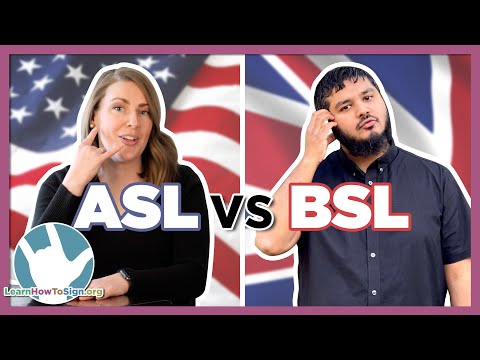
British Sign Language vs American sign language is a comparison that surprises many people. Despite the UK and US sharing English as a spoken language, BSL and ASL are completely different sign languages that are mutually unintelligible. A BSL user cannot understand ASL, and vice versa. Understanding these differences dispels common myths and reveals the fascinating diversity of sign languages worldwide.
Key Differences Between BSL and ASL
The most immediately obvious difference is the manual alphabet. BSL uses a two-handed alphabet where both hands work together to form letters. ASL uses a one-handed alphabet performed with the dominant hand alone. This fundamental difference means fingerspelling looks completely different in each language.
Vocabulary differs extensively between the two languages. Common signs like thank you, please, and hello look entirely different in BSL and ASL. Even concepts that might seem universal are expressed through distinct handshapes, movements, and locations. There is no predictable relationship between BSL and ASL signs for the same concept.
Number systems differ between the two languages. BSL and ASL have different signs for numbers, with distinct handshapes and counting conventions. This seemingly simple aspect of language shows how independently the two systems developed and evolved.
Research suggests that BSL and ASL share less than 30 percent of their vocabulary, roughly comparable to the similarity between two unrelated spoken languages. They are classified in entirely different sign language families — BSL belongs to the BANZSL family, while ASL belongs to the French Sign Language family.
Historical Origins
BSL evolved organically within Britain’s Deaf communities over centuries. Regional Deaf schools, Deaf clubs, and social networks shaped the language as it developed. BSL’s roots are in Britain’s indigenous Deaf community, with no significant influence from other countries’ sign languages.
ASL has very different origins. It was heavily influenced by French Sign Language (LSF), brought to America by Laurent Clerc, a Deaf teacher from France, in 1817. Clerc co-founded the American School for the Deaf in Connecticut, where French signs merged with existing American Deaf community signs to form what became ASL.
This French connection explains why ASL actually has more in common with LSF than with BSL. ASL and LSF share a significant proportion of their vocabulary and some grammatical features, despite being used on different continents. Meanwhile, BSL and ASL, used by countries sharing a spoken language, are quite distinct.
The history demonstrates that sign languages develop independently of spoken languages. They follow their own paths of evolution, influenced by community contact, education systems, and cultural factors rather than by the spoken language used in the surrounding hearing population.
Practice Makes Perfect
Test your sign language skills with our free practice app.
Grammar and Structure Compared
Both BSL and ASL are visual-spatial languages with grammar distinct from English, but their grammatical structures differ from each other. BSL typically uses a topic-comment sentence structure, while ASL tends toward a subject-verb-object order, though both languages are flexible in their word order depending on context.
Facial expressions serve grammatical functions in both languages, but the specific patterns differ. BSL and ASL use different mouth patterns, eyebrow positions, and head movements to mark questions, negation, and emphasis. A BSL user’s grammatical facial expressions would not convey the same meanings to an ASL user.
Both languages use spatial grammar, establishing locations in the signing space to represent people and concepts. However, the conventions for spatial reference may differ between the two languages. The way classifiers are used — handshapes representing categories of objects — also varies between BSL and ASL.
Temporal marking works differently in each language. Both place time references at strategic points in sentences, but the specific signs for time concepts and the conventions for establishing temporal frameworks differ. Understanding these grammatical differences highlights that BSL and ASL are truly independent language systems.
Cultural Differences
The Deaf communities in the UK and US have distinct cultural traditions shaped by their different histories. British Deaf culture has been influenced by the UK’s social welfare system, the NHS, and the long tradition of Deaf clubs. American Deaf culture reflects the US’s educational system, particularly the influence of Gallaudet University, the world’s only university designed entirely for Deaf students.
Attitudes toward Deaf identity and language rights differ between the two countries. The US has had the Americans with Disabilities Act since 1990, providing legal protections that influenced Deaf Americans’ expectations of access. The UK’s BSL Act 2022 came much later, though the Equality Act 2010 provided some protections earlier.
The Deaf community in each country has its own art forms, humour, and social conventions. BSL poetry looks and feels different from ASL poetry, reflecting the different visual aesthetics of each language. Deaf theatre, film, and television have developed along distinct paths in each country.
International Deaf events, such as the Deaflympics and World Federation of the Deaf congresses, bring BSL and ASL users together. In these settings, International Sign — a contact variety of signing used between people with different sign languages — facilitates communication across language boundaries.
Which Should You Learn
Your choice between BSL and ASL should depend on where you live and who you want to communicate with. If you’re in the UK, Ireland, or countries that use BSL-related sign languages (Australia, New Zealand), learn BSL. If you’re in the US, Canada, or countries with ASL influence, learn ASL.
Consider your purpose for learning. If your goal is communicating with a specific Deaf person, learn whatever sign language they use. If you’re pursuing a career in interpreting, train in the sign language relevant to your country. For general interest, choose the language that matches your likely Deaf community contacts.
Learning one sign language does give you transferable skills that help with learning another. While BSL and ASL are different languages, the visual-spatial thinking, non-manual communication skills, and cultural awareness you develop are applicable across sign languages. Some people who become fluent in one sign language choose to learn another later.
Whichever language you choose, engagement with the Deaf community is essential for genuine fluency. Both BSL and ASL are living languages best learned through interaction with native users, not just from courses and apps. The rewarding experience of communicating in someone else’s language is the same regardless of which sign language you pursue.
Related Articles
Practice ASL Signs
Use your camera to practice signs and get real-time AI feedback on your technique.
Free · No signup required