
American Sign Language Vs British Sign Language

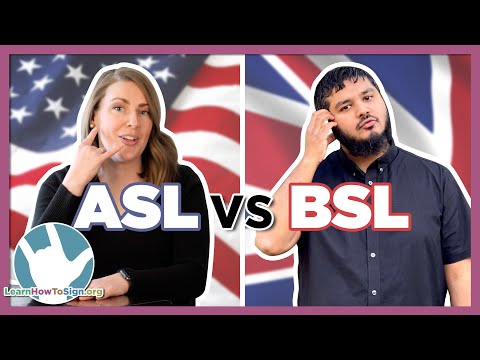
Comparing American Sign Language vs British Sign Language is one of the most eye-opening exercises in linguistics. Despite both being used in predominantly English-speaking countries, ASL and BSL are completely separate languages with different origins, different alphabets, and largely different vocabularies. Understanding their differences helps dispel the common myth that sign language is universal.
Why ASL and BSL Are Different Languages
The reason American Sign Language and British Sign Language are so different lies in their separate historical origins. BSL developed naturally within the British Deaf community over hundreds of years, with the earliest known references to organised sign language use in Britain dating to the 16th century. It evolved through Deaf schools, residential institutions, and community gatherings across England, Scotland, and Wales.
ASL, on the other hand, has predominantly French roots. In 1817, Thomas Hopkins Gallaudet and Laurent Clerc — a Deaf educator from the Paris school for the Deaf — established the American School for the Deaf in Hartford, Connecticut. Clerc taught using French Sign Language (LSF), which merged with existing local sign systems to create the foundation of modern ASL.
The reason Gallaudet did not bring BSL to America was pragmatic rather than linguistic. The Braidwood family, who controlled most Deaf education in Britain at the time, treated their teaching methods as commercial secrets and refused to share them. This historical accident sent American Deaf education down a French-influenced path, creating a permanent divergence between the sign languages of two English-speaking nations.
Today, linguistic research confirms that ASL is more closely related to French Sign Language than to BSL. Studies of vocabulary overlap show roughly 60 percent shared signs between ASL and LSF, compared to only about 30 percent between ASL and BSL. BSL, meanwhile, shares its closest relationships with Australian Sign Language (Auslan) and New Zealand Sign Language (NZSL) in the BANZSL family.
One-Handed vs Two-Handed Alphabets
The fingerspelling systems of ASL and BSL represent perhaps their most visually obvious difference. ASL uses a one-handed alphabet derived from the French manual alphabet, where each of the 26 letters is formed by a single hand. BSL uses a two-handed alphabet with historical roots in British Deaf education, where both hands work together to create each letter.
In the ASL one-handed system, most letters are static hand positions. The letter A is a closed fist with the thumb alongside, B is a flat hand with fingers together and thumb tucked, and C is a curved hand forming the shape of the letter. Only two letters — J and Z — involve movement, with the hand tracing the shape of the letter in the air.
Practice Makes Perfect
Test your sign language skills with our free practice app.
In the BSL two-handed system, one hand typically acts as the base while the other creates the distinguishing features. Vowels are formed by touching specific fingertips on the non-dominant hand, creating a logical pattern that moves from thumb (A) to little finger (U). Consonants use a variety of formations including flat palm backdrops, finger positioning, and hand orientations.
These alphabet differences have practical implications. ASL fingerspelling can be done with one hand, leaving the other free. BSL fingerspelling requires both hands but produces larger letter forms that may be easier to read from a distance. Neither system is inherently superior — each is well suited to its language community. Learning the BSL alphabet is an essential first step for anyone studying signs like hello and building their vocabulary.
Sign Vocabulary Differences
The vocabulary differences between ASL and BSL are vast. For nearly every concept, ASL and BSL use entirely different signs. The sign for “thank you” in ASL (a flat hand moving away from the chin) looks nothing like the BSL sign for thank you. The same is true for fundamental vocabulary covering family, emotions, everyday objects, and abstract concepts.
Even where occasional similarities exist — sometimes due to coincidence, sometimes due to the shared concept of iconicity (where a sign visually represents its meaning) — the overall vocabulary overlap is minimal. A fluent ASL signer visiting London would struggle to understand BSL conversation, and a BSL signer in New York would face the same challenge with ASL.
Number systems also differ between the two languages. ASL numbers are formed with one hand, while BSL uses both hands for some numbers. The way larger numbers are constructed and the conventions for expressing monetary amounts, dates, and times all follow different patterns in each language.
Regional variation exists within both languages as well. ASL has dialectal differences between regions of the United States, and Black ASL — the variety used within the African American Deaf community — has its own distinctive features. BSL has regional dialects across England, Scotland, Wales, and Northern Ireland, with signs for colours, numbers, and common objects varying between regions. Signs for everyday concepts like good and bad may have regional variants within BSL itself.
Grammar and Sentence Structure
While ASL and BSL are both visual-spatial languages, their grammatical systems have notable differences. Both languages use the space in front of the signer to establish references, both employ facial expressions as grammatical markers, and both use classifiers to depict objects and actions. However, the specific rules governing these features are not identical.
ASL word order is often described as following a Subject-Verb-Object or topic-comment structure, with significant flexibility depending on context. The language makes extensive use of what linguists call “aspect” — modifications to verb signs that indicate whether an action is ongoing, completed, or habitual. These aspect markers involve changes to the sign’s movement pattern.
BSL also uses topic-comment structure but places greater emphasis on mouthing — the production of English word shapes on the lips while signing. In BSL, mouth patterns serve important grammatical functions, helping to distinguish between signs that might otherwise look identical. This feature is present in ASL but is less systematically grammatical.
Questions are formed differently in the two languages. Both use facial expression changes (raised eyebrows for yes/no questions, furrowed brows for wh-questions), but the specific non-manual markers and their timing relative to the signed words can differ. The way negation is expressed also varies, with each language having its own set of negative signs and non-manual negation markers.
Verb agreement — the way verbs are modified to show who is acting upon whom — is a feature of both languages but follows different conventions. Both ASL and BSL use directional verbs that move between established spatial references, but the specific verbs that show agreement and the rules for how agreement works are language-specific.
Deaf Culture in America and Britain
The Deaf communities in America and Britain have parallel but distinct cultural traditions. Gallaudet University has been central to American Deaf culture since 1864, serving as an intellectual and cultural hub where ASL flourishes and Deaf identity is celebrated. The Deaf President Now protest of 1988, where students demanded a Deaf president for Gallaudet, became a watershed moment for Deaf rights in America.
In Britain, the Deaf community has historically centred around regional Deaf clubs and the British Deaf Association. The campaign for legal recognition of BSL culminated in the BSL Act of 2022, which formally recognised BSL as a language of England, Wales, and Scotland. This legislative achievement came decades after the Deaf community began advocating for recognition.
Both communities have rich traditions in Deaf arts, including theatre, poetry, film, and visual arts. American Deaf theatre has a strong tradition through organisations like the National Theatre of the Deaf, while British Deaf arts are supported through organisations such as Deafinitely Theatre. Both traditions create art forms that are unique to sign language and Deaf experience.
Despite their linguistic differences, the American and British Deaf communities share core values: pride in Deaf identity, commitment to sign language rights, emphasis on visual communication, and a strong sense of community belonging. When members of these communities meet at international events, they often find common ground quickly through shared experiences of navigating a hearing world.
For learners interested in exploring either language, resources abound. Deafened.org provides dictionary entries for both ASL and BSL signs, and community organisations in both countries offer classes for hearing people who want to learn. Whichever language you choose, you will be entering a rich linguistic and cultural tradition that has been sustained by Deaf communities for generations.
Related Articles
Practice ASL Signs
Use your camera to practice signs and get real-time AI feedback on your technique.
Free · No signup required