
ASL Vs BSL Differences You Need to Know

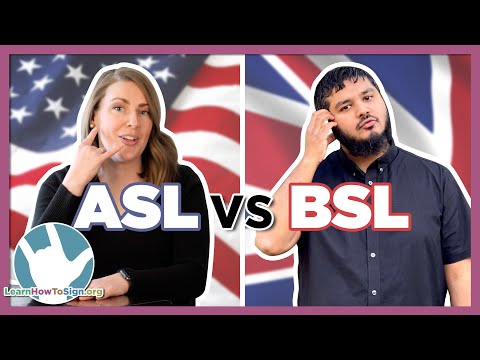
Understanding the ASL vs BSL differences is essential for anyone interested in sign language, whether you are choosing which language to learn or simply curious about how sign languages work. American Sign Language and British Sign Language differ in virtually every aspect — from their historical origins and alphabet systems to their vocabulary, grammar, and the cultural communities that use them.
Historical and Family Differences
The most fundamental difference between ASL and BSL is their linguistic heritage. These two languages evolved from completely separate roots, placing them in different sign language families. BSL developed organically within Britain’s Deaf community over hundreds of years, while ASL grew from French Sign Language (LSF) after Laurent Clerc brought LSF to America in 1817.
BSL belongs to the BANZSL family, which also includes Australian Sign Language (Auslan) and New Zealand Sign Language (NZSL). These three languages share around 80 percent of their vocabulary because Auslan and NZSL both developed from BSL through historical migration patterns. A BSL signer can understand a significant portion of Auslan conversation without formal study.
ASL belongs to the French Sign Language family, sharing approximately 60 percent of its vocabulary with LSF. This means a French Deaf person and an American Deaf person have more potential for mutual understanding than an American Deaf person and a British Deaf person — a counterintuitive fact that surprises most hearing people.
The overlap between ASL and BSL is estimated at roughly 30 percent, which is about the same level of coincidental similarity you would find between any two unrelated sign languages. This figure conclusively demonstrates that ASL and BSL are not dialects of the same language but entirely separate linguistic systems that must be learned independently.
Alphabet and Number Differences
The fingerspelling systems represent the most visually obvious ASL vs BSL difference. ASL employs a one-handed alphabet inherited from the French manual system. Each of the 26 letters is formed by the dominant hand alone, with most letters being static handshapes and only J and Z involving movement.
BSL uses a two-handed alphabet with centuries-old British origins. Both hands work together to form each letter, with one hand typically serving as a base and the other creating the defining feature. The vowels follow a logical thumb-to-little-finger pattern, while consonants use various two-handed configurations.
Practice Makes Perfect
Test your sign language skills with our free practice app.
No letter in the ASL alphabet looks the same as the corresponding letter in the BSL alphabet. Even letters that seem like they should be similar — like C, which is somewhat iconic in both systems — are formed differently because the BSL version involves both hands while the ASL version uses only one. This means learning one alphabet provides zero transferable knowledge for the other.
Number systems also differ substantially. ASL counts from one to five starting with the index finger, using one hand for numbers up to nine and two hands for larger numbers. BSL uses different starting formations, and the conventions for expressing two-digit numbers, fractions, and monetary values follow entirely separate rules. Even something as simple as counting to ten requires separate learning for each language.
Vocabulary Differences in Daily Signs
The vocabulary differences between ASL and BSL extend across every category of daily communication. Greetings, family terms, food vocabulary, emotional expressions, and action verbs are all signed differently in each language. A learner who has memorised hundreds of ASL signs would need to start essentially from scratch when learning BSL, and vice versa.
Consider basic greetings. The ASL sign for “hello” involves a hand near the forehead in a salute-like motion. The BSL sign for hello is formed completely differently. Similarly, “thank you” in ASL moves a flat hand away from the chin, while BSL’s thank you uses an unrelated formation. These foundational vocabulary differences set the tone for the entire learning experience.
Emotional vocabulary shows the same pattern. The BSL signs for happy, sad, angry, and scared bear no resemblance to their ASL counterparts. While both languages sometimes use iconic representations — where the sign visually depicts the concept — the specific iconicity choices differ. What seems like an obvious visual representation in one culture may not carry the same associations in another.
Even signs for concrete, everyday objects like table, chair, cup, and car are different between ASL and BSL. Some degree of overlap exists in highly iconic signs — where the visual representation is so universal that signers independently arrive at similar forms — but these coincidental similarities are the exception rather than the rule.
Grammar and Linguistic Differences
While ASL and BSL share some broad features common to visual-spatial languages — use of signing space, facial grammar, classifiers, and directional verbs — the specific grammatical rules and conventions of each language are distinct.
One significant grammatical difference involves mouthing. In BSL, the production of English word shapes on the lips while signing serves a systematic grammatical function. Mouth patterns can distinguish between signs with identical hand movements, effectively adding an extra layer of phonological information. While ASL signers also mouth words, this feature is less grammatically central in ASL than in BSL.
Verb aspect — the modification of verb signs to show whether an action is ongoing, completed, habitual, or repeated — works differently in each language. ASL has a well-studied system where verb movement is altered in specific ways to express different aspects. BSL also marks aspect, but the specific movement modifications and their meanings do not directly correspond to ASL’s system.
Negation provides another point of contrast. Both languages use head shakes as non-manual negation markers, but the specific negative signs and the rules for where negation can be placed in a sentence differ. ASL has specific negation patterns for different types of negative statements, and BSL has its own conventions that an ASL signer would not automatically understand.
Spatial grammar — the use of locations in signing space to represent people, places, and things — is a feature of both languages, but the conventions for establishing and maintaining spatial references are not identical. The rules for which verbs agree with spatial locations, how locations are established, and how spatial references interact with other grammatical features all show language-specific patterns.
Cultural and Community Differences
Beyond the linguistic differences, ASL and BSL are embedded in distinct cultural communities with their own histories, institutions, and social norms. The American Deaf community centres around institutions like Gallaudet University (founded 1864), the National Association of the Deaf, and a network of residential Deaf schools that have served as cultural incubators for generations.
The British Deaf community has its own institutional landscape, including the British Deaf Association (founded 1890), a tradition of regional Deaf clubs, and a growing network of BSL-using educational programs. The passage of the BSL Act in 2022, formally recognising BSL as a language of England, Wales, and Scotland, was a landmark achievement in the history of British Deaf rights.
Social conventions within each community also differ. Norms around attention-getting (how you signal that you want someone to look at you), turn-taking in conversation, name-giving customs, and social etiquette at Deaf events have developed independently in each community. What is considered polite or appropriate in one community may not carry the same significance in the other.
Deaf media and arts traditions reflect these cultural differences as well. American Deaf cinema, theatre, and literature have their own genres, notable works, and artistic conventions. British Deaf arts have developed independently, influenced by British cultural contexts and the specific experiences of the British Deaf community. For learners of BSL, exploring signs for cultural concepts like music opens the door to understanding how the language expresses aesthetic and artistic ideas.
Despite their many differences, the American and British Deaf communities share fundamental values: the importance of sign language as a natural right, pride in Deaf identity, and commitment to community. International events such as the Deaflympics and World Federation of the Deaf congresses bring these communities together, and the shared experience of being Deaf in a hearing world creates bonds that transcend linguistic differences.
Related Articles
Practice ASL Signs
Use your camera to practice signs and get real-time AI feedback on your technique.
Free · No signup required