
What Is BSL Sign Language? Everything You Need to Know

If you’re asking what is BSL sign language, the short answer is that BSL stands for British Sign Language — the visual-spatial language used by the Deaf community across the United Kingdom. But there’s much more to understand: BSL is a complete natural language with its own grammar, a rich history, and a vibrant community of over 150,000 users who rely on it as their primary means of communication.
BSL Is a Real Language
BSL is not a simplified communication system or a visual code for English. It is a complete natural language with the same linguistic complexity as any spoken language. Linguists have confirmed that BSL has phonology (building blocks of signs), morphology (how signs change form to change meaning), syntax (sentence structure rules), semantics (meaning), and pragmatics (context-dependent use) — the full set of properties that define a human language.
BSL has its own grammar that differs fundamentally from English. It uses topic-comment sentence structure, facial expressions for grammatical functions, three-dimensional spatial grammar, and sign modifications that have no equivalent in spoken languages. A BSL sentence follows different rules from an English sentence, just as a French sentence follows different rules from a Chinese one.
The Deaf community has used BSL for centuries, passing it between generations through families and schools. BSL is a living language that evolves — new signs emerge for new concepts, regional dialects reflect community diversity, and usage changes over time. It carries cultural meaning, artistic tradition, and community identity alongside its communicative function.
The BSL Act 2022 formally recognised BSL as a language of England, Wales, and Scotland, giving it legal status for the first time. This recognition validated what linguists and the Deaf community had long established: BSL is not a lesser form of communication but a genuine language deserving the same respect and institutional support as any spoken language.
How BSL Communicates
BSL uses five parameters to create meaning: handshape (how the fingers and palm are configured), location (where the sign is produced relative to the body), movement (the direction and type of motion), orientation (which way the palm faces), and non-manual features (facial expressions, mouth patterns, and body movements). Changing any one parameter can change the meaning of a sign, just as changing a sound changes the meaning of a spoken word.
Facial expressions serve grammatical functions in BSL that are mandatory, not decorative. Raised eyebrows mark yes/no questions. Furrowed eyebrows mark information questions. Head movements indicate negation. Mouth patterns accompany specific signs. A BSL sentence signed without appropriate facial expression is grammatically incomplete — like an English sentence spoken without intonation or punctuation.
The space in front of the signer is used productively. People, objects, and concepts can be “placed” at specific locations in this signing space, then referenced by pointing toward those locations. This spatial grammar enables BSL to handle complex referencing, describe physical layouts, show movement between locations, and maintain multiple conversation topics simultaneously.
Practice Makes Perfect
Test your sign language skills with our free practice app.
The BSL manual alphabet uses both hands to form 26 letters, allowing any English word to be fingerspelled. Fingerspelling is used for names, technical terms, and unfamiliar vocabulary. It serves as a bridge between BSL and written English, though it’s a relatively small part of normal BSL conversation — most communication uses vocabulary signs rather than fingerspelling.
BSL Is Not Universal Sign Language
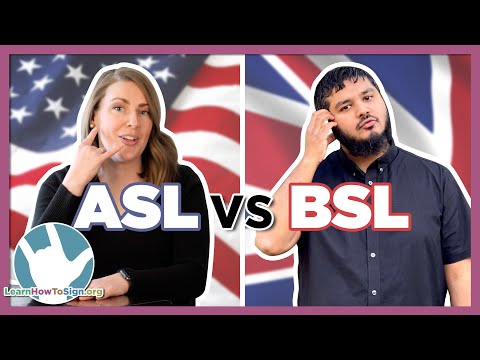
One of the most common misconceptions is that sign language is universal — that all Deaf people worldwide use the same signs. In reality, over 300 distinct sign languages exist, each tied to specific Deaf communities. BSL is the sign language of the UK, just as ASL is the sign language of the US, and they are completely different languages.
BSL and ASL are mutually unintelligible. They use different alphabets (two-handed vs one-handed), different vocabularies, and different grammar rules. A BSL user meeting an ASL user would face the same communication barrier as an English speaker meeting a Mandarin speaker. The shared spoken language of their countries (English) has no bearing on the sign languages, which evolved independently.
BSL belongs to the BANZSL language family alongside Auslan (Australian Sign Language) and NZSL (New Zealand Sign Language). These three languages share historical roots through British colonial-era Deaf education and retain some mutual intelligibility. This family relationship is BSL’s closest linguistic connection — not ASL, not “international sign language.”
International Sign (IS) exists as a contact language used at international Deaf events, but it is not a natural language — it’s a negotiated communication system that draws on features from many sign languages. IS enables cross-linguistic interaction at conferences and the Deaflympics but doesn’t replace any community’s native sign language for everyday communication.
Starting Your BSL Journey
BSL courses accredited by Signature are available across the UK at colleges, Deaf organisations, and online. Level 1 is the beginner qualification, teaching the alphabet, core vocabulary, basic grammar, and Deaf cultural awareness over 20 to 30 weeks. Costs range from £150 to £500, with subsidised places available in some areas.
Free resources provide an accessible way to explore BSL before committing to a course. YouTube channels from Deaf educators offer structured lessons. BSL SignBank provides a free online dictionary with video demonstrations. Social media platforms host Deaf creators sharing daily BSL content. These resources build vocabulary and basic awareness at no cost.
The Deaf community welcomes learners who approach with genuine interest. Attending Deaf clubs and events provides real-world practice that accelerates your learning and deepens your cultural understanding. Don’t wait until you feel “good enough” — early community engagement makes everything that follows easier and more meaningful.
Learning BSL sign language connects you with a remarkable community, develops a valuable life skill, and contributes to a more accessible society. Whether your motivation is personal, professional, or purely curiosity-driven, BSL rewards your investment with the ability to communicate across the hearing-Deaf divide and the privilege of engaging with a rich cultural and linguistic tradition.
Related Articles
Practice ASL Signs
Use your camera to practice signs and get real-time AI feedback on your technique.
Free · No signup required