
What Does BSL Mean in Sign Language? Full Explanation

BSL stands for British Sign Language — the visual-spatial language used by the Deaf community across the United Kingdom. Understanding what does BSL mean in sign language goes beyond the abbreviation: it refers to a complete, independent language with its own grammar, vocabulary, regional dialects, and cultural context, used by over 150,000 people as their primary or preferred means of communication.
BSL: British Sign Language Defined
British Sign Language is a visual-spatial language that uses hand movements, facial expressions, body posture, and the space around the signer to convey meaning. It is not a manual version of English — BSL has its own grammar, syntax, and linguistic rules that are completely independent of the English language. A sentence in BSL follows different structural patterns from the equivalent English sentence.
BSL is the preferred language of the Deaf community in England, Scotland, and Wales. It’s also used in Northern Ireland alongside Irish Sign Language (ISL). The BSL Act 2022 formally recognised BSL as a language of England, Wales, and Scotland, giving it legal status for the first time and establishing government duties to promote its use.
The abbreviation BSL is widely used in the UK and internationally to distinguish British Sign Language from other sign languages. In conversation — both signed and spoken — people typically say or fingerspell “BSL” rather than the full name “British Sign Language.” Within the Deaf community, BSL is understood as referring specifically to the language, while “signing” or “sign language” may be used more generally.
BSL has been used by Deaf people in Britain for centuries, though it was only recognised as a language by linguists in the 1970s and by the UK government in 2003 (informally) and 2022 (legally). This long history of community use without institutional recognition reflects broader patterns of sign language marginalisation that Deaf communities worldwide have fought to overcome.
What Makes BSL a Real Language
BSL meets every linguistic criterion for a natural human language. It has phonology (the building blocks of signs — handshape, location, movement, orientation, and non-manual features), morphology (ways signs are modified to change meaning), syntax (rules for combining signs into sentences), semantics (meaning), and pragmatics (context-dependent language use). These are the same fundamental properties that define all human languages.
BSL has its own grammar that differs from English in fundamental ways. It uses topic-comment sentence structure rather than English’s subject-verb-object order. It conveys grammatical information through facial expressions — raised eyebrows for yes/no questions, furrowed eyebrows for information questions. It uses the three-dimensional space in front of the signer to establish references, show relationships, and convey spatial information in ways that spoken languages cannot.
BSL has regional dialects, just like spoken English varies between regions. A BSL user from Glasgow signs differently from one in London or Cardiff — different vocabulary signs for common concepts, different number systems in some cases, and different stylistic preferences. These regional variations developed naturally in Deaf communities across Britain, often influenced by the local Deaf school that served each area.
Practice Makes Perfect
Test your sign language skills with our free practice app.
BSL evolves over time, as all living languages do. New signs emerge for new concepts (technology, social media, contemporary culture), old signs fall out of use, and influences from other languages (including English and other sign languages) shape its ongoing development. BSL today is different from BSL fifty years ago, and it will continue to change as the community that uses it evolves.
How BSL Relates to Other Sign Languages
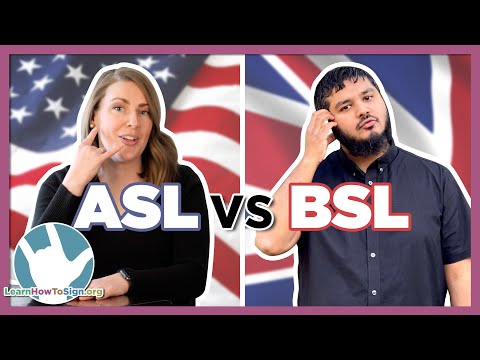
BSL is not related to ASL (American Sign Language), despite both being used in English-speaking countries. ASL descended from French Sign Language (LSF) and has more in common with LSF than with BSL. BSL and ASL use different alphabets (two-handed vs one-handed), different vocabularies, and different specific grammar rules. A BSL user and an ASL user cannot understand each other without prior cross-learning.
BSL belongs to the BANZSL language family alongside Auslan (Australian Sign Language) and NZSL (New Zealand Sign Language). These three languages share a common historical origin in British Deaf education — Australia and New Zealand’s early Deaf schools were established by British educators who brought BSL with them. The three languages retain some mutual intelligibility, particularly at the vocabulary level, though they have diverged over time.
There are over 300 documented sign languages worldwide, each independent and tied to specific Deaf communities. Sign languages are not universal — this is one of the most common misconceptions people hold. Just as spoken languages vary between countries and regions, sign languages developed independently in different Deaf communities around the world, each reflecting its own history and culture.
International Sign (IS) is a contact language used at international Deaf events and by the World Federation of the Deaf. It draws on features from many sign languages and relies heavily on iconic signs (signs that visually represent their meaning). IS is not a natural language like BSL — it’s a negotiated communication system that enables cross-linguistic interaction, similar to pidgin languages in the spoken world.
BSL and the Deaf Community
BSL is central to Deaf identity and culture in Britain. For many Deaf people, BSL is not just a communication tool but a defining element of who they are. Deaf culture encompasses shared values, social norms, artistic traditions, and community bonds that are expressed through and shaped by BSL. Learning BSL is therefore an engagement with a living culture, not just the acquisition of a skill.
The British Deaf Association, founded in 1890, is the oldest Deaf-led organisation in the world and has been central to advocating for BSL’s recognition and the Deaf community’s rights. Regional Deaf associations, Deaf clubs, and community organisations across the UK provide the infrastructure for community life, social connection, and cultural continuity.
The Deaf community distinguishes between deaf (a medical condition describing hearing loss) and Deaf (a cultural identity centred on BSL use and membership of the Deaf community). Not all deaf people are Deaf — some do not use sign language or identify with Deaf culture. And some hearing people (particularly children of Deaf adults, known as CODAs) are culturally Deaf through their upbringing in the BSL-using community.
For hearing people, learning BSL represents a meaningful step toward accessibility and inclusion. Every hearing person who learns BSL creates one more point of access for Deaf people in daily life — at work, in shops, at social events, in public services. Understanding what BSL means goes beyond knowing an abbreviation: it means recognising and valuing a language community that contributes richly to British life.
Related Articles
Practice ASL Signs
Use your camera to practice signs and get real-time AI feedback on your technique.
Free · No signup required