
Interpreting in British Sign Language (BSL)

The sign for “British Sign Language interpreting” is used within the UK Deaf community to refer to the process of translating spoken language into BSL. It’s commonly used in educational and professional settings where Deaf individuals need access to information in their native language. This sign highlights the importance of effective communication and accessibility.
How to Sign “Interpreting” in BSL
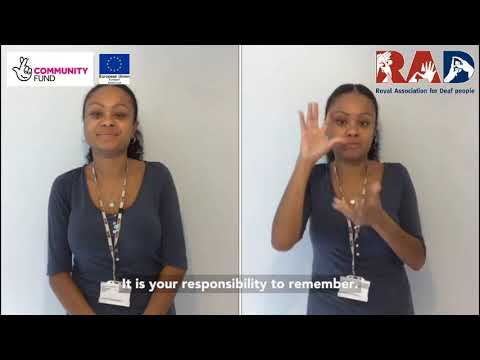
- Start with your dominant hand in a flat ‘5’ handshape (fingers spread) at your chest level.
- Place your non-dominant hand in a ‘B’ handshape (flat) underneath your dominant hand, palm facing up.
- Move your dominant hand forward and slightly away from your body, as if conveying information from one hand to the other.
- Maintain eye contact with your audience and use facial expressions to convey the importance of the communication.
Common Mistakes
- Forgetting to use non-manual features like facial expressions, which are vital for conveying meaning in BSL.
- Not keeping the movement fluid; the sign should flow naturally to emphasise the act of interpreting.
- Using incorrect hand shapes; ensure the dominant hand is in a flat ‘5’ and the non-dominant hand is a ‘B’.
BSL vs ASL
In BSL, the sign for interpreting involves a specific handshape and movement that reflects the act of translating between languages. In contrast, ASL uses a different handshape and a more direct movement to indicate interpreting. This highlights the unique characteristics of each sign language, shaped by their respective cultures.
Related Signs
- BSL – The sign for British Sign Language itself.
- 1 – The sign for the number one.
- 10 – The sign for the number ten.
- 100 – The sign for the number one hundred.
- 11 – The sign for the number eleven.
Frequently Asked Questions
How can I use “interpreting” in a BSL sentence?
You can use the sign in a sentence like “I need an interpreter” by signing “I” (point to yourself) followed by “NEED” (with both hands in a ‘B’ shape moving towards you) and then “INTERPRETING” as explained above.
Are there regional variations of this sign in the UK?
While the sign is generally consistent, some regional variations may exist in the movement or speed in different areas of the UK, particularly in Northern Ireland or Scotland.
What is a similar sign to “interpreting”?
A similar sign would be “translate,” which uses a more direct movement and may vary slightly in handshape, often focusing on the action of changing words from one language to another.
Any tips for learning this sign?
Practice in front of a mirror to ensure your handshapes and movements are accurate, and watch videos of native signers to understand the fluidity of the sign.
Is “interpreting” used frequently in BSL?
Yes, it’s a common sign, especially in contexts involving education, healthcare, and public services, where effective communication is crucial for access.
What are the non-manual features I should use?
Facial expressions such as raising your eyebrows can indicate the importance of the information being conveyed, which is essential in BSL grammar.
Practice ASL Signs
Use your camera to practice signs and get real-time AI feedback on your technique.
Free · No signup required