
ASL Grammar Rules for Beginners: A Clear Guide
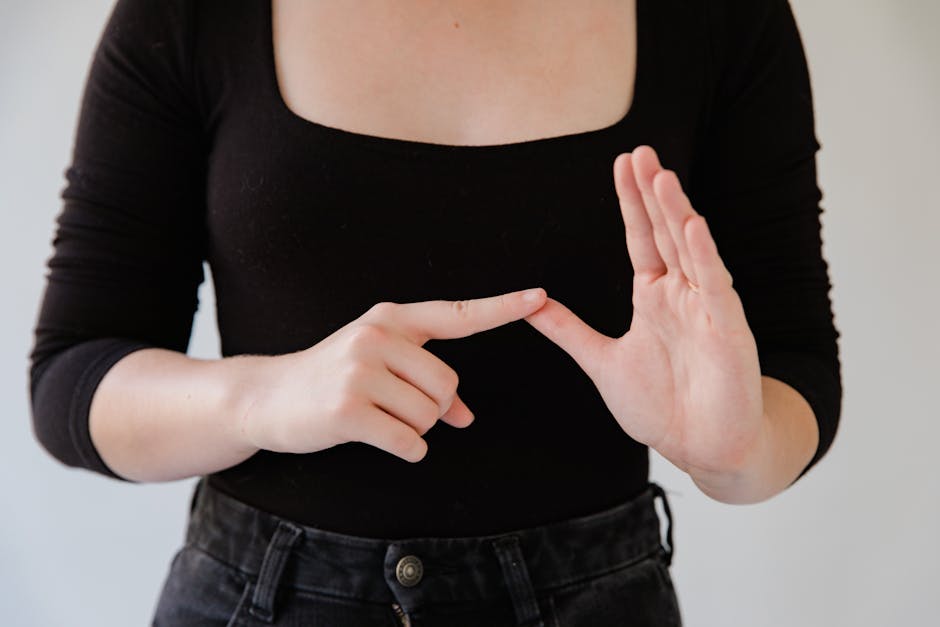
If you are learning American Sign Language, understanding ASL grammar rules for beginners is the single most important step after learning your first vocabulary. ASL is not English on the hands — it is a complete language with its own syntax, word order, and grammatical structures. Trying to sign in English word order is the number one mistake new learners make, and it makes your signing hard for Deaf people to follow.
Table of Contents
ASL Is Not English: Why Grammar Matters
American Sign Language evolved independently from English, with roots in French Sign Language (LSF) brought to the United States by Laurent Clerc in 1817. It shares more grammatical features with Japanese and Navajo than with English. Understanding this helps you stop trying to translate English sentences word-for-word into signs.
English relies heavily on word order and auxiliary verbs: “I have been going to the store.” ASL conveys the same information using spatial relationships, facial expressions, and movement modifications. The ASL equivalent would look something like: STORE, ME GO-repeatedly (with a facial expression indicating ongoing action). Fewer signs, different order, same meaning.
Linguists at Gallaudet University have documented that ASL has all the hallmarks of a natural language: a consistent phonological system (based on handshape, location, movement, orientation, and non-manual signals), morphological rules for modifying meaning, and a syntax that native signers acquire naturally as children.
For beginners, the practical takeaway is this: learn ASL grammar rules from the start rather than building bad habits that you will need to unlearn later. Your signing will be more natural, more readable, and more respectful of ASL as a language.
Topic-Comment Structure
The most fundamental ASL grammar rule is topic-comment structure. In English, we use subject-verb-object order: “The dog chased the cat.” In ASL, you typically establish the topic first, then comment on it.
For example, the English sentence “I like pizza” becomes PIZZA, ME LIKE in ASL. The topic (pizza) is established first with raised eyebrows, then the comment (I like it) follows. This is similar to saying “As for pizza, I like it” in English.
Topic-comment structure is not the only word order in ASL — subject-verb-object order is also used, especially in simple declarative sentences. But topic-comment is the dominant structure for conveying new information, and it is the pattern most unfamiliar to English speakers.
When establishing the topic, your eyebrows raise slightly and your head tilts forward. This non-manual marker signals to the viewer that you are setting up the topic. When you shift to the comment, your eyebrows return to neutral or take on the appropriate expression for the comment (such as a question face or an affirmative nod).
Practice by converting simple English sentences: “My brother is tall” becomes BROTHER MY, TALL. “The movie was boring” becomes MOVIE, BORING. Start with this pattern and it will become automatic.
Practice Makes Perfect
Test your sign language skills with our free practice app.
Facial Grammar and Non-Manual Signals
In ASL, your face is not just expressing emotion — it is performing essential grammatical functions. Facial expressions in ASL are called non-manual signals (NMS), and they are as important as the hand movements themselves.
Raised eyebrows mark yes/no questions. Furrowed eyebrows with a slight head tilt mark wh-questions (who, what, where, when, why, how). If you sign WHERE without the furrowed brow, it reads as a statement rather than a question. This is why facial expressions are not optional in ASL — they carry grammatical meaning.
Head nodding and shaking function as affirmation and negation. A sentence signed with a continuous head shake becomes negative even without the sign for NOT. For example, signing ME LIKE with a head shake means “I don’t like it.”
Mouth morphemes — specific mouth movements that are not based on English words — modify meaning. For example, the mouth shape “cha” (mouth open with tongue slightly visible) indicates something large. The mouth shape “mm” with pursed lips indicates normalcy or something done with ease. These are not random — they are rule-governed grammatical markers.
Beginners often feel self-conscious about using facial expressions. Push through this discomfort. Signing with a flat face is the ASL equivalent of speaking in a monotone with no inflection — technically intelligible but socially strange and grammatically ambiguous.
Time Indicators and Tense
ASL does not conjugate verbs for tense the way English does (walk, walked, will walk). Instead, ASL establishes the time frame at the beginning of a sentence, and all subsequent signs are understood to occur within that time frame until a new time indicator is given.
Common time indicators include YESTERDAY, TODAY, TOMORROW, LAST WEEK, NEXT MONTH, LONG AGO, and RECENTLY. These are typically signed at the start of a sentence or topic: YESTERDAY, ME GO STORE — “I went to the store yesterday.”
The ASL time line is an imaginary line running from behind your shoulder (past) through your body (present) to in front of you (future). Signs related to the past move backward; signs related to the future move forward. This spatial representation of time is consistent and intuitive once you understand the concept.
Once you establish a time frame, you do not need to repeat it for every sentence in a conversation. If you sign LAST WEEK at the beginning of a story, everything that follows is understood to have happened last week until you sign a new time indicator. This is more efficient than English, which requires tense marking on every verb.
Pronouns and Spatial Referencing
ASL pronouns are remarkably logical. Point to yourself for “I/me,” point to the person you are talking to for “you,” and point to a third person or an established location in space for “he/she/they.” There is no gender distinction in ASL pronouns — the same point is used for he, she, and they.
Spatial referencing, also called indexing, is one of ASL’s most powerful grammatical features. When you introduce a person or thing into a conversation, you assign them a location in the space in front of you. Your brother might be set up on your left, your sister on your right. From that point on, pointing to those locations refers to those people.
Verb agreement in ASL often involves directional movement between established spatial locations. The sign for GIVE moves from the giver to the receiver. If your brother (left) gave something to your sister (right), the sign GIVE would move from left to right. This spatial verb agreement replaces English word order for clarifying who did what to whom.
For beginners, start by practicing with two people: set one up on your left and one on your right. Tell a simple story involving both of them, pointing to each location when referring to them and directing verbs appropriately. This builds the spatial thinking that fluent ASL requires.
Negation and Questions
ASL has several ways to negate a sentence. The most basic is adding NOT or shaking your head while signing. But ASL also has negative incorporation — signs that have a built-in negative meaning. KNOW becomes DON’T-KNOW with a single modified movement. LIKE becomes DON’T-LIKE. WANT becomes DON’T-WANT. These incorporated negatives are faster and more natural than signing two separate words.
Questions in ASL fall into two categories with distinct facial grammar. Yes/no questions use raised eyebrows and a slight forward lean: “YOU DEAF?” (with raised eyebrows). Wh-questions use furrowed eyebrows and a head tilt: “YOU NAME WHAT?” (with furrowed eyebrows).
Rhetorical questions are also common in ASL and serve a different purpose than in English. A rhetorical question sets up information: “ME GO WHERE? STORE.” The signer asks and then answers their own question as a way of structuring information. The facial marker for rhetorical questions is raised eyebrows held during the question, with a slight pause before the answer.
Mastering these grammatical fundamentals takes practice, but it transforms your signing from “English with hands” into actual ASL. Deaf community members will immediately notice the difference, and your conversations will flow more naturally. Combine these grammar rules with regular vocabulary building from resources like Deafened.org’s ASL dictionary to accelerate your progress.
Related Articles
- ASL Sentence Structure Explained
- ASL Facial Expressions and Their Meaning
- Complete Guide to ASL Classifiers
- ASL vs. Signed English Differences
Practice ASL Signs
Use your camera to practice signs and get real-time AI feedback on your technique.
Free · No signup required