
Conversational Basic Sign Language: Essential Phrases to Start Signing
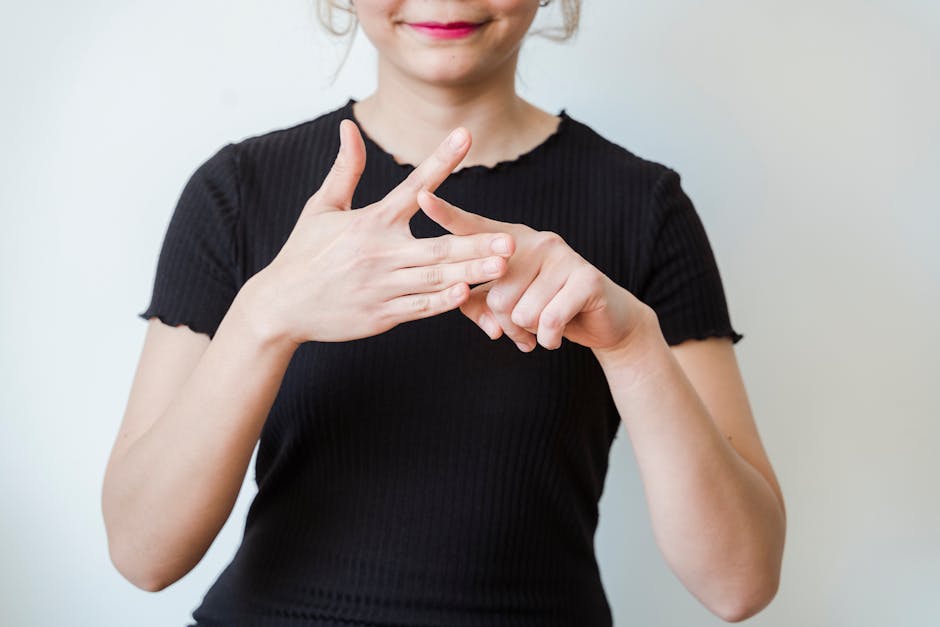
Learning conversational basic sign language is one of the most rewarding steps you can take toward communicating with the Deaf and hard-of-hearing community. Unlike memorizing vocabulary lists, conversational signing focuses on the phrases and structures you actually need to hold a real exchange — greetings, questions, responses, and polite expressions that keep dialogue flowing naturally.
Table of Contents
Why Start with Conversational Signing
Many sign language courses begin with the alphabet and numbers, which are important building blocks. However, research in second-language acquisition shows that learners who practice conversational phrases early build confidence and retain vocabulary more effectively than those who focus solely on isolated signs.
Conversational basic sign language gives you the tools to interact with Deaf individuals right away, even with a limited vocabulary. A simple exchange of greetings, names, and polite phrases demonstrates respect for the language and the community. The National Association of the Deaf (NAD) encourages hearing people to learn even basic conversational signs as a way to promote accessibility and inclusion.
Starting with conversation also helps you internalize the visual grammar of ASL, which differs significantly from English. You begin to understand that ASL is not “English on the hands” but a complete language with its own syntax, idioms, and cultural rules governing how dialogue works.
Essential Greetings and Introductions
Every conversation starts with a greeting. In ASL, the sign for hello is performed by bringing your open hand to your forehead in a small salute-like motion, then moving it outward. It is friendly, simple, and universally recognized in the Deaf community.
To introduce yourself, use the phrase structure: “MY NAME [fingerspell your name].” The sign for NAME is made by crossing your two index and middle fingers in an H-handshape and tapping them together. Then fingerspell your name using the ASL alphabet. If your name is long, many Deaf individuals will offer you a “name sign” — a personalized sign that represents you — after getting to know you.
Other key introductory phrases include:
- “NICE MEET YOU” — The equivalent of “Nice to meet you.” Sign NICE (flat hand slides across palm), MEET (index fingers come together), and point to the person for YOU.
- “HOW YOU?” — This is “How are you?” in ASL word order. Raise your eyebrows (indicating a yes/no question) while signing.
- “ME FINE” — A common response meaning “I’m fine.” Touch your thumb to your chest with an open 5-handshape.
- “YOUR NAME WHAT?” — “What is your name?” Use a WH-question face (eyebrows furrowed) because this is a WH-question.
Practice Makes Perfect
Test your sign language skills with our free practice app.
Asking and Answering Questions
Questions are the backbone of any conversation. In ASL, there are two main question types, and your facial expression signals which type you are using. Yes/no questions use raised eyebrows, while WH-questions (who, what, where, when, why, how) use furrowed eyebrows with the question word typically placed at the end of the sentence.
Essential question signs to learn include:
- WHAT — Hold both hands open, palms up, and shake them slightly side to side.
- WHERE — Point your index finger up and wave it side to side with furrowed eyebrows.
- WHO — Circle your index finger around your pursed lips.
- WHY — Touch your forehead with your middle finger, then pull it forward into a Y-handshape.
- HOW — Place both fists together, thumbs up, and roll them forward while opening the hands.
Practice forming simple questions: “YOU DEAF?” (raised eyebrows), “YOU LEARN SIGN WHERE?” (furrowed eyebrows), and “YOU UNDERSTAND?” (raised eyebrows). Mastering the facial grammar is just as important as getting the hand movements right — without proper non-manual signals, your question may be misread as a statement.
Everyday Conversational Phrases
Beyond greetings and questions, a handful of everyday phrases will carry you through most basic exchanges. The signs for thank you, sorry, and please are essential for polite conversation.
Here are high-frequency conversational phrases every beginner should know:
- “PLEASE SLOW” — Ask someone to sign more slowly. This is perfectly acceptable and appreciated.
- “AGAIN PLEASE” — Ask someone to repeat what they signed.
- “ME UNDERSTAND LITTLE” — Honestly communicate your skill level. Deaf signers will adjust their speed and complexity.
- “EXCUSE ME” — Brush your fingertips across your opposite palm to politely get attention.
- “ME LEARN ASL” — Let the other person know you are a student. This builds goodwill and patience.
When ending a conversation, you can sign “NICE TALK YOU” (Nice talking to you), “SEE YOU LATER” (wave with a casual facial expression), or simply “BYE” with a friendly wave. Deaf culture values direct communication, so a simple and clear farewell is always appropriate.
Understanding ASL Sentence Structure
One of the biggest adjustments for English speakers learning conversational basic sign language is understanding that ASL has its own grammar. The most common sentence structures in ASL include topic-comment and subject-verb-object, but they differ from English word order.
For example, in English you might say “I am going to the store.” In ASL, this becomes “STORE ME GO” — the topic (store) comes first, followed by the comment (I’m going there). This topic-comment structure is fundamental to how ASL organizes information.
Time indicators come at the beginning of sentences. If you want to say “Yesterday I went to school,” you sign “YESTERDAY ME GO SCHOOL.” This establishes the time frame first, and all subsequent signs are understood to be in that time context until a new time marker appears.
Negation works differently too. Instead of adding “not” before a verb, you sign the verb while shaking your head and using a negative facial expression. “ME UNDERSTAND” with a head shake becomes “I don’t understand.” The sign for no can also be used for emphasis, but the head shake alone often carries the negation in fluid conversation.
Tips for Building Signing Fluency
Building fluency in conversational sign language requires consistent practice and real-world interaction. Here are strategies recommended by Deaf educators and interpreter training programs:
Attend Deaf events and socials. Many communities host ASL social nights, Deaf coffee chats, or meetup groups where learners can practice with native signers. These low-pressure environments are ideal for building confidence. Check with your local Deaf association for event calendars.
Practice with a mirror or video recording. Watching yourself sign helps you refine handshapes, facial expressions, and signing space. Record short conversational exchanges and review them to identify areas for improvement.
Learn in phrases, not isolated words. Just as you would learn “How are you?” as a unit in a foreign language class, learn ASL phrases as complete expressions. This builds muscle memory for natural signing flow.
Watch ASL content daily. Follow Deaf vloggers, watch ASL storytelling on social media, and immerse yourself in visual language as much as possible. Passive exposure builds receptive skills — your ability to understand what others sign — which is often the harder skill to develop.
Be patient with yourself and others. Fluency takes time. Most learners need 2-3 years of consistent study and practice to achieve conversational fluency. Celebrate small milestones like your first successful exchange with a Deaf person, and keep building from there. Browse our ASL Dictionary to expand your vocabulary between practice sessions.
Related Articles
- Best Way to Learn Sign Language at Home
- Best Sign Language Apps for Learning
- Deaf Culture and Etiquette Guide
- Sign Language Learning Guides
Practice ASL Signs
Use your camera to practice signs and get real-time AI feedback on your technique.
Free · No signup required