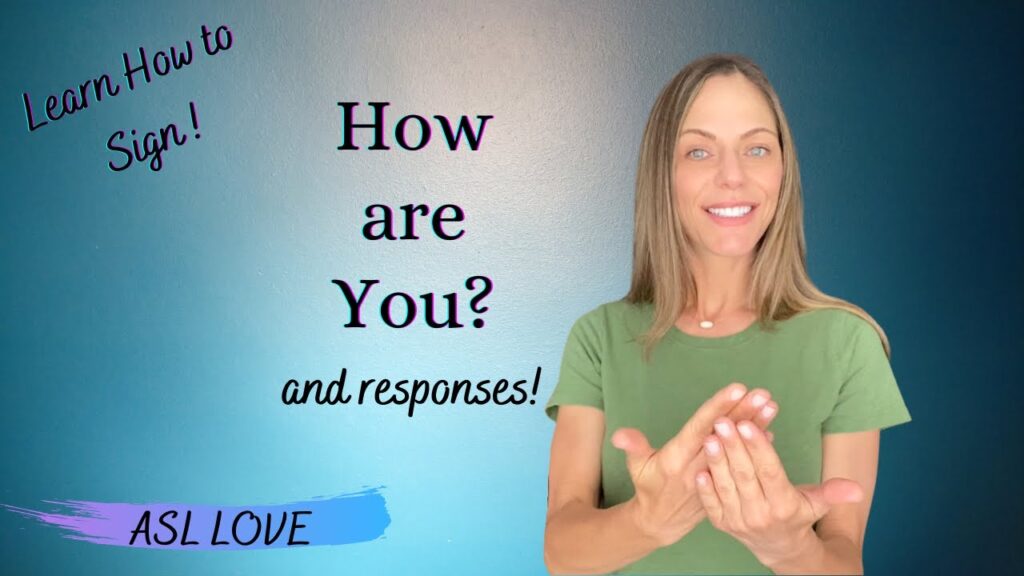
How Are You in Sign Language (ASL)

How to sign How Are You in ASL
Practice sign language with AI coachingTry it free →

The sign for “how are you” is a friendly greeting used to ask someone about their well-being. It’s commonly used in everyday conversations among friends, family, and acquaintances in the Deaf community. This sign helps to foster connection and shows that you care about the other person’s feelings.

Last reviewed: March 15, 2026

Frequently Asked Questions

How do I use the sign for ‘How are you’ in sentences?

You can use the sign for ‘How are you’ at the beginning of a conversation to greet someone. For example, you might sign ‘How are you?’ followed by a topic you want to discuss, like ‘I am good, thank you!’

Are there regional variations of the sign for ‘How are you’?

Yes, there can be slight variations in the sign depending on the region or community. For instance, some areas may use a more exaggerated movement, while others may have a subtler approach, so it’s beneficial to observe and adapt to the local signs used by the Deaf community.

Is there a difference between formal and informal usage of this sign?

While the sign for ‘How are you’ is appropriate in both formal and informal contexts, the accompanying facial expression and body language may vary. In formal settings, you might maintain a more neutral expression, whereas in casual interactions, a friendly smile can enhance the greeting.

What are some similar or easily confused signs?

The sign for ‘How are you’ can be confused with ‘What’ or ‘How’ depending on handshape and movement. Practicing with a Deaf friend or teacher can help clarify these differences and ensure accurate communication.

How does the sign for ‘How are you’ compare to BSL?

In British Sign Language (BSL), the sign for ‘How are you’ differs significantly from ASL. BSL uses a different handshape and movement, so it’s essential to learn the appropriate gestures for the sign language you’re using.

What are some teaching tips for the sign ‘How are you’?

When teaching this sign, emphasize the importance of facial expressions and context. Use role-playing scenarios to practice greetings, and encourage students to watch native signers to observe how the sign is used naturally in conversation.

Table of Contents

Sign at a Glance

Type Adverb
Sign Type Asymmetricalsamehandshape
Location Hand
Handshape c
Movement Curved
Iconicity Arbitrary (1.452/7) — Arbitrary
Frequency Common (5.815/7)

Data: ASL-LEX 2.0 (Caselli et al., 2017)

How to Sign “How Are You”

  1. Start with both hands in front of your chest, palms facing upward.
  2. Form the letter “H” with both hands. This is done by extending your index and middle fingers while folding down the other fingers.
  3. Move both “H” hands outward from your chest, while maintaining the “H” shape. This movement should be gentle and open, as if you are drawing someone in.
  4. As you perform the sign, raise your eyebrows to convey a questioning expression, showing that you are asking about their well-being.

Common Mistakes

One common mistake is not using the correct handshape; some learners may inadvertently use a flat hand instead of the “H” shape. Another mistake is forgetting to include facial expressions, which are essential in ASL to convey meaning. Lastly, some might rush the movement, leading to a less clear sign.

  • 23 – A sign used to indicate the number twenty-three.
  • 9 – The sign for the number nine.
  • A – The sign for the letter A.
  • Abcs – A sign representing the alphabet.
  • Again – A sign used to request repetition.

Practice ASL Signs

Use your camera to practice signs and get real-time AI feedback on your technique.

Start Practicing →

Free · No signup required