
Australian Sign Language Vs British

Comparing Australian sign language vs British sign language reveals a fascinating relationship between two closely related visual languages. Auslan evolved from BSL, and the two languages share a significant amount of vocabulary and structural features. Yet they have also diverged in meaningful ways over more than two centuries of independent development on opposite sides of the globe.
Shared Origins of Auslan and BSL
Australian sign language vs British sign language is fundamentally a comparison between parent and offspring. Auslan developed from BSL when Deaf settlers, educators, and missionaries from Britain and Ireland arrived in Australia during the nineteenth century. The first schools for Deaf children in Australia were established by people who brought BSL (and some Irish Sign Language) with them.
The earliest recorded Deaf education in Australia dates to the 1860s, when schools were established in Sydney, Melbourne, and other colonial capitals. These schools used the sign language their founders knew — BSL — which then began evolving in the Australian context. New signs emerged for Australian concepts, and the language gradually developed its own character while retaining its BSL foundation.
By the twentieth century, Auslan had developed enough distinctive features to be recognised as a separate language rather than simply a dialect of BSL. The name “Auslan” was coined in the 1980s by Trevor Johnston, a linguist at Macquarie University, to give the language its own identity distinct from BSL. This naming was an important step in recognising Auslan as a language in its own right.
The shared history means that Auslan retains many features of BSL, including the two-handed fingerspelling alphabet, many core vocabulary signs, and similar grammatical structures. However, more than 150 years of independent evolution have introduced significant differences that make Auslan a distinct language rather than a variety of BSL.
Vocabulary Similarities and Differences
Linguists estimate that Auslan and BSL share roughly 80 percent of their vocabulary, though this figure varies depending on the dialect and the specific signs being compared. Core vocabulary — signs for basic concepts like family members, common objects, and everyday actions — tends to be more similar, while newer signs and culture-specific concepts show greater divergence.
Signs unique to Auslan often relate to Australian geography, culture, and daily life. There are Auslan signs for Australian cities, local wildlife (kangaroo, koala, wombat), Australian sports and institutions, and concepts that are culturally significant in Australia. These signs have no BSL equivalents because they refer to concepts that are specifically Australian.
Conversely, BSL has signs for British-specific concepts that have no direct Auslan equivalent. The sign for “pounds” (currency), British place names, and culturally specific British concepts are unique to BSL. When an Auslan signer encounters these concepts, they would typically fingerspell the word or use a descriptive sign combination.
Some signs that exist in both languages have shifted in meaning over time. A sign that meant one thing in BSL may have taken on a slightly different nuance in Auslan, or a sign that was common in BSL in the 1860s may have fallen out of use in modern BSL while being preserved in Auslan. These semantic shifts are a natural part of language evolution and mirror similar processes in spoken languages.
The BANZSL Language Family
Auslan and BSL are part of the BANZSL language family, which also includes New Zealand Sign Language (NZSL). The term BANZSL was coined to recognise the genetic relationship between these three sign languages while acknowledging that each has developed into a distinct language. Some linguists consider BANZSL a language family, while others view the three as closely related dialects of a single language.
NZSL is the third member of this family, having developed from BSL through similar historical processes as Auslan. Deaf educators from Britain established schools in New Zealand, bringing BSL with them, and the language evolved independently in the New Zealand context. NZSL also incorporated elements from Australasian Sign Language due to geographic and cultural connections between Australia and New Zealand.
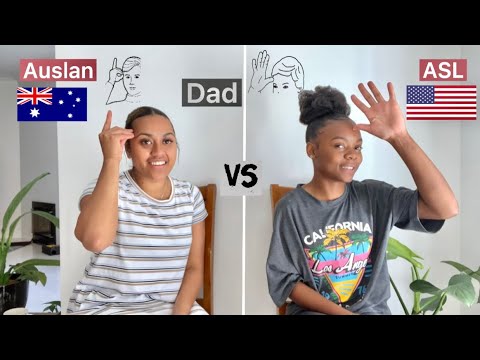
The BANZSL family stands in contrast to the French Sign Language family, which includes American Sign Language, LSF, and many other sign languages worldwide. Understanding these family relationships helps clarify why Auslan and BSL are so similar to each other yet so different from ASL — they belong to different branches of the sign language family tree.
Research into the BANZSL family has contributed significantly to our understanding of how sign languages evolve. By studying the similarities and differences between BSL, Auslan, and NZSL, linguists can trace patterns of language change, identify which features are stable over time, and understand how geographic separation and cultural factors drive linguistic divergence.
Practice Makes Perfect
Test your sign language skills with our free practice app.
Cultural and Community Differences
The Deaf communities of Australia and Britain have developed in different national contexts, leading to distinct cultural practices and institutions. The British Deaf community is one of the oldest organised Deaf communities in the world, with the British Deaf Association established in 1890. BSL was officially recognised as a language by the UK government in 2003, and the BSL Act 2022 further strengthened its legal status.
Australia’s Deaf community has its own long history, with state Deaf societies established in the late nineteenth century. Auslan was recognised as a community language by the Australian government in 1991. Deaf Australia serves as the national peak body, advocating for the rights and interests of Deaf Australians at the federal level.
Educational approaches have varied between the two countries, though both experienced the devastating impact of oralism — the philosophy that prohibited sign language in Deaf education in favour of speech and lip-reading. The oralist period, lasting roughly from the 1880s to the 1980s, disrupted natural sign language transmission in both countries. The recovery from oralism has taken different forms in each community.
Despite their differences, the Deaf communities of Australia and Britain maintain strong connections. Many Deaf Australians have British heritage, and there is regular exchange between the two communities through travel, social media, and international Deaf events. The high degree of mutual intelligibility between Auslan and BSL facilitates these cross-cultural connections.
Mutual Intelligibility Between Auslan and BSL
Unlike the relationship between Auslan and ASL (which are not mutually intelligible), Auslan and BSL signers can generally understand each other with relative ease. The high percentage of shared vocabulary and similar grammatical structures mean that communication between Auslan and BSL users is often possible without a formal interpreter, though some adjustment and clarification may be needed.
The degree of mutual intelligibility varies depending on the topic of conversation and the individuals involved. Everyday conversation about familiar topics tends to be easily understood. However, discussions involving technical vocabulary, culture-specific concepts, or heavy use of newer signs that have diverged between the two languages may require more negotiation and fingerspelling.
Deaf travellers between Australia and the United Kingdom often report being pleasantly surprised at how well they can communicate with local Deaf communities. While some signs require adjustment, the overall experience is much more like encountering a regional dialect than a foreign language. This ease of communication reinforces the close family relationship between the two languages.
The mutual intelligibility of Auslan and BSL has practical implications for sign language resources and media. Some educational materials, particularly those focused on fingerspelling and basic vocabulary, can be used across both language communities with minor modifications. However, it is always best to use language-specific resources to ensure accuracy and to respect the distinct identity of each language and its community.
Related Articles
- Australian Sign Language Vs American
- Australian Sign Language Vs ASL
- What Is Australian Sign Language
Practice ASL Signs
Use your camera to practice signs and get real-time AI feedback on your technique.
Free · No signup required