
ASL vs Auslan – Key Differences Explained

When comparing ASL vs Auslan, many people are surprised to learn that these two sign languages are mutually unintelligible despite both being used in English-speaking countries. American Sign Language and Australian Sign Language developed from entirely different roots, resulting in distinct vocabularies, grammatical structures, and fingerspelling systems.
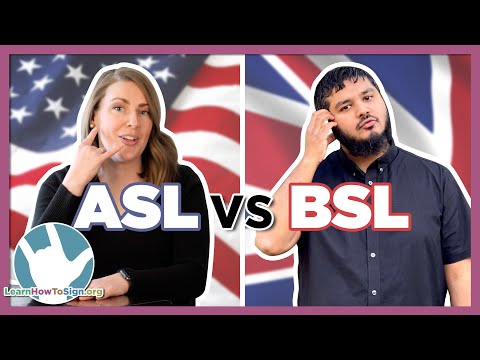
Different Historical Origins
The fundamental reason ASL and Auslan are so different lies in their separate historical lineages. ASL traces its origins primarily to French Sign Language (LSF), brought to the United States by Laurent Clerc, a Deaf educator from France, who co-founded the first permanent school for the Deaf in Hartford, Connecticut, in 1817. ASL evolved from the blending of LSF with indigenous sign systems already used by Deaf Americans.
Auslan, by contrast, descends from British Sign Language (BSL). When Deaf schools were established in Australia during the 19th century, many of the teachers came from Britain and brought BSL with them. Over time, BSL adapted and evolved within the Australian context, incorporating local signs and developing its own regional variations. This is why Auslan shares far more in common with BSL and New Zealand Sign Language than with ASL.
This historical split means that ASL and Auslan belong to different sign language families. ASL is part of the French Sign Language family, which also includes LSF, Irish Sign Language, and several other sign languages influenced by French deaf education. Auslan belongs to the BANZSL (British, Australian, New Zealand Sign Language) family, a group of closely related sign languages that share a common ancestor in BSL.
Understanding these origins helps explain why an ASL signer and an Auslan signer cannot simply understand each other. They are using completely different languages, not regional dialects of a single sign language. The common misconception that sign language is universal persists, but the reality is that sign languages are as diverse as spoken languages.
Fingerspelling: One Hand vs. Two
Perhaps the most immediately visible difference between ASL and Auslan is their fingerspelling systems. ASL uses a one-handed manual alphabet, where each letter is formed with a single hand held in front of the signer. This system allows the non-dominant hand to remain free for other purposes during a fingerspelled word.
Auslan uses a two-handed manual alphabet inherited from BSL. Letters are formed using both hands together, with various configurations of fingers and palm orientations. The two-handed system is visually quite different from ASL’s one-handed approach, and the letter formations themselves bear little resemblance to their ASL counterparts.
This difference has practical implications. ASL fingerspelling tends to be faster because it requires coordinating only one hand. Auslan fingerspelling, while potentially slower, is often considered easier to read from a distance because the two-handed formations create larger, more distinct shapes. Both systems are equally effective within their respective communities.
For anyone learning both languages, the fingerspelling systems require completely separate practice. Skills in one system do not transfer to the other, and attempting to mix them creates confusion. If you already know the ASL manual alphabet and want to learn Auslan fingerspelling, expect to invest significant practice time in building the new motor patterns.
Practice Makes Perfect
Test your sign language skills with our free practice app.
Vocabulary and Sign Differences
The core vocabularies of ASL and Auslan share very few signs. Even basic concepts like hello, thank you, and family are signed completely differently in each language. An ASL signer watching Auslan for the first time would recognize almost nothing, much as an English speaker would struggle with Mandarin Chinese.
There are occasional overlaps where both languages happen to use similar signs, but these are typically coincidental rather than evidence of shared heritage. Some iconic signs — where the sign visually resembles what it represents — may look similar across many sign languages simply because both communities arrived at similar visual depictions. For example, signs for “eating” or “drinking” may share some resemblance across unrelated sign languages because they mime the physical action.
Number systems also differ between ASL and Auslan. While both use finger counting, the specific handshapes and starting configurations vary. Auslan, like BSL, begins counting with the thumb, while ASL begins with the index finger. This small difference can cause confusion in cross-language interactions, particularly when discussing quantities, prices, or addresses.
Regional variation within each language adds another layer of complexity. Both ASL and Auslan have regional dialects — Auslan varies between states like Victoria, New South Wales, and Queensland, while ASL varies across different regions of the United States. Two signers of the same language may use different signs for the same concept, making cross-language comparison even more nuanced.
Grammar and Sentence Structure
Both ASL and Auslan have their own grammatical systems independent of English. Neither follows English word order, and both use spatial grammar, facial expressions, and body movements as integral grammatical components. However, their specific grammatical rules differ in important ways.
ASL commonly uses a topic-comment sentence structure, where the topic is established first and then commented upon. For example, “The store, I went” would be a natural ASL sentence structure. Auslan also uses topicalization but tends to follow subject-verb-object order more frequently, reflecting different grammatical conventions that evolved within each community.
Both languages use non-manual markers — facial expressions, head movements, and body shifts — as essential grammar. Raised eyebrows, for instance, mark yes/no questions in both ASL and Auslan. However, the specific non-manual markers and their grammatical functions may differ in subtle ways that only experienced signers would notice.
Aspect and tense are handled differently as well. Both languages establish time references at the beginning of a conversation or narrative, but the specific signs used for time markers and the ways verbs are modified for aspect (whether an action is ongoing, completed, or habitual) reflect each language’s unique grammatical development.
Cultural Context and Community
The Deaf communities that use ASL and Auslan have developed distinct cultural practices and identities shaped by their respective national contexts. The American Deaf community, with an estimated 500,000 ASL users, has a rich institutional framework including Gallaudet University, the National Association of the Deaf (NAD), and a network of residential schools that have served as cultural centers for generations.
The Australian Deaf community, while smaller, has equally deep cultural roots. Deaf Australia (formerly the Australian Association of the Deaf) advocates for Deaf rights and recognition of Auslan. Australia officially recognized Auslan as a community language in 1991, a significant milestone for the Deaf community. The country’s Deaf schools, particularly in Melbourne and Sydney, have played central roles in Auslan’s development and preservation.
Despite their linguistic differences, ASL and Auslan communities share many cultural values common to Deaf communities worldwide. These include visual orientation, the importance of Deaf schools and social spaces, storytelling traditions, and advocacy for linguistic and civil rights. International Deaf events, such as the Deaflympics and World Federation of the Deaf conferences, bring these communities together despite language barriers.
When ASL and Auslan signers meet, they often resort to International Sign (IS), a contact variety used at international Deaf events. IS draws on signs from multiple sign languages and relies heavily on iconic and gestural elements. While not a full language itself, IS serves as a practical bridge between Deaf people from different linguistic backgrounds, allowing the kind of cross-cultural communication that unites the global Deaf community.
Related Articles
Practice ASL Signs
Use your camera to practice signs and get real-time AI feedback on your technique.
Free · No signup required