
American Sign Language vs New Zealand Sign Language

Comparing American Sign Language vs New Zealand Sign Language reveals two distinct languages from different sign language families. ASL descended from French Sign Language, while NZSL shares roots with British Sign Language. Despite both being used in English-speaking countries, they have different alphabets, vocabularies, and grammar — though NZSL has absorbed some ASL influence through media and international Deaf contact.
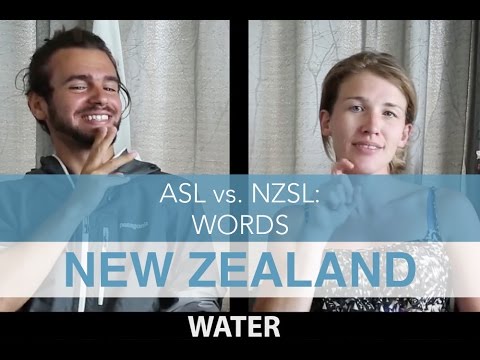
Different Language Families
NZSL belongs to the BANZSL language family alongside BSL (British Sign Language) and Auslan (Australian Sign Language). New Zealand’s early Deaf education was established by British educators who brought BSL with them, giving NZSL British linguistic roots. Over time, NZSL developed its own vocabulary, grammar features, and cultural identity distinct from its parent language.
ASL descended from French Sign Language (LSF), introduced to America in 1817. The ASL language family includes numerous sign languages across the Americas and beyond that were influenced by French Deaf education. ASL’s French heritage means it has more in common linguistically with LSF than with either BSL or NZSL.
These different ancestries mean NZSL and ASL evolved from completely separate starting points. An NZSL user would find BSL or Auslan partially familiar (same family) but ASL largely foreign (different family). The two languages share only the broad features common to all visual-spatial languages rather than specific vocabulary or grammar from shared heritage.
New Zealand’s geographic isolation and small Deaf community (estimated at 4,500 NZSL users) have shaped a language with unique characteristics — including significant Māori cultural influence that neither ASL nor BSL shares.
Alphabet and Vocabulary
NZSL uses a two-handed manual alphabet inherited from BSL, while ASL uses a one-handed alphabet from the French tradition. This fundamental difference means fingerspelling — used for names, places, and technical terms — is completely incompatible between the two languages. The two-handed vs one-handed distinction is the quickest way to identify which language family a signer belongs to.
Core vocabulary differs substantially. Everyday signs for family members, food, colours, emotions, and common verbs are mostly different between NZSL and ASL. However, some ASL vocabulary has been borrowed into NZSL through American media exposure and international Deaf contact, creating a small layer of shared vocabulary that doesn’t exist between BSL and ASL.
NZSL includes signs derived from Māori language and culture that are unique to New Zealand. Concepts related to Māori customs, places, and cultural practices have NZSL signs that reflect the bicultural nature of New Zealand society. These signs have no equivalent in ASL, BSL, or any other sign language.
Practice Makes Perfect
Test your sign language skills with our free practice app.
Number systems differ between NZSL and ASL. While NZSL’s number system has some similarities to BSL’s (reflecting shared heritage), it has also developed its own variations. ASL numbers follow the French Sign Language tradition with entirely different handshapes. Basic numerical communication requires knowing the specific system of whichever language you’re using.
Unique Features of NZSL
NZSL was one of the first sign languages in the world to receive full legal recognition. The New Zealand Sign Language Act 2006 declared NZSL an official language of New Zealand alongside English and Māori. This legal status means NZSL users have the right to use NZSL in legal proceedings and when accessing government services.
The influence of Māori culture on NZSL extends beyond vocabulary. Deaf Māori have developed signs that reflect tikanga Māori (Māori customs and protocols), creating a cultural layer within NZSL that enriches the language and connects Deaf Māori to both their Deaf and Māori identities. This bicultural dimension is unique to NZSL.
NZSL’s small community creates both challenges and intimacy. With fewer than 5,000 users, the NZSL community is tight-knit, and the language has less regional variation than larger sign languages like BSL or ASL. Most NZSL users know each other within one or two degrees of connection, creating a community dynamic quite different from the larger, more dispersed ASL-using community.
Deaf education in New Zealand has influenced NZSL’s development significantly. The two main residential Deaf schools — Kelston in Auckland and van Asch in Christchurch — each contributed to NZSL’s vocabulary and conventions. Some regional differences between North Island and South Island NZSL reflect these school communities.
Choosing Which to Learn
If you’re in New Zealand or communicating with the New Zealand Deaf community, learn NZSL. If you’re in North America, learn ASL. The choice is geographic and community-based. Neither language is more complete or expressive than the other — both serve their communities with equal richness.
NZSL resources are more limited than ASL resources due to the smaller community. However, Deaf Aotearoa New Zealand, Victoria University of Wellington’s Deaf Studies programme, and online NZSL dictionaries provide learning materials. NZSL courses are available in major New Zealand cities.
Learning either language develops transferable skills — visual processing, spatial awareness, and facial expression comfort — that would help with the other. But the specific alphabet, vocabulary, and grammar differ sufficiently that learning one doesn’t automatically give you the other. Each requires dedicated study.
The comparison between American Sign Language vs New Zealand Sign Language illustrates the diversity of sign languages worldwide. Over 300 distinct sign languages exist, each reflecting its community’s unique history, culture, and development. NZSL’s blend of British sign language heritage and Māori cultural influence makes it a uniquely New Zealand creation.
Related Articles
Practice ASL Signs
Use your camera to practice signs and get real-time AI feedback on your technique.
Free · No signup required