
British and American in British Sign Language (BSL)
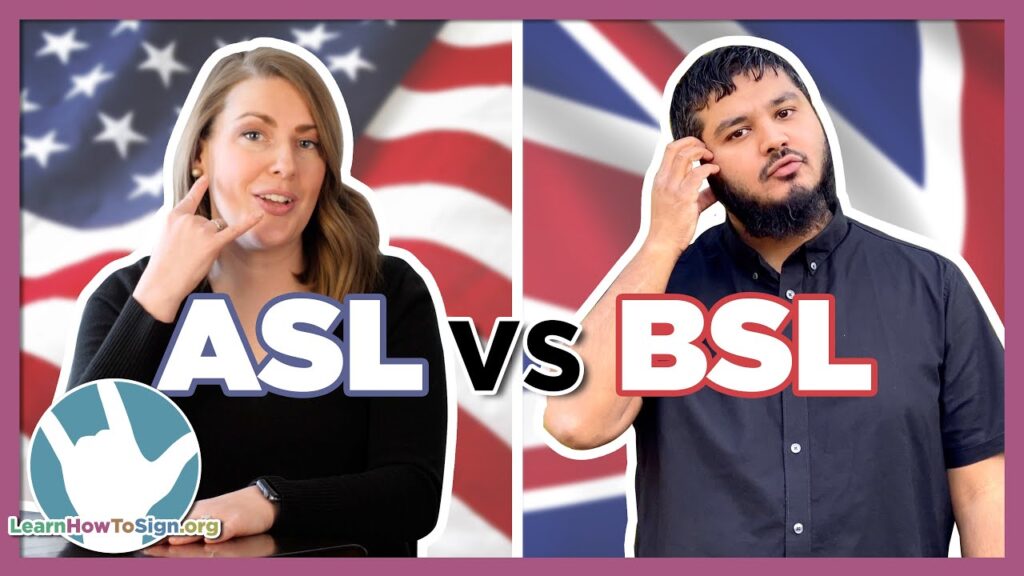
The sign for “British and American Sign Language” is used when discussing both BSL and ASL, highlighting their differences and similarities. This sign is commonly used in educational settings, workshops, and discussions within the UK Deaf community to promote understanding of these two distinct sign languages.
How to Sign “British And American” in BSL
- Start with both hands in a flat handshape (like a ‘B’ handshape) held in front of you, palms facing inwards.
- Position your hands slightly apart, about shoulder-width.
- Move your right hand towards the right side of your body, while your left hand stays in place, representing “British”.
- Then, bring your right hand back to the centre and move your left hand to the left side of your body, representing “American”.
- Throughout the sign, maintain a neutral facial expression, or use a slight nod to indicate that you are discussing two separate sign languages.
Common Mistakes
- Forgetting to use both hands, which can confuse the meaning of the sign.
- Using a single, static position instead of the movement that distinguishes the two sign languages.
- Not maintaining appropriate facial expressions, which are important for conveying meaning in BSL.
BSL vs ASL
In ASL, the sign for “American Sign Language” is different in both handshape and movement compared to BSL. While BSL uses a flat handshape to represent both languages, ASL may incorporate different hand configurations and movements, reflecting the unique grammar and structure of each sign language.
Related Signs
- (Bsl – A reference to British Sign Language in a general context.
- (Bsl) – Another variation or aspect of BSL.
- 1 – The number sign for “one” in BSL.
- 1 Dollar – The sign for “one dollar” in BSL.
- 10 – The number sign for “ten” in BSL.
Frequently Asked Questions
How can I use this sign in a sentence?
You can say, “I am learning both British and American Sign Language,” using the sign for “British and American” to clarify your topic.
Are there regional variations in BSL for this sign?
While the sign is generally consistent across the UK, some regions may have slight variations in the movement or handshape. It’s best to observe local users.
Are there similar signs I should know?
Yes, the signs for other numbers and basic concepts can be useful, like 10 or 1.
What tips do you have for learning this sign?
Practice in front of a mirror to ensure your movements are clear, and consider joining a Deaf group or class for feedback.
Can I use this sign in formal settings?
Absolutely! This sign is appropriate in educational and professional contexts where discussing BSL and ASL is relevant.
Why is the facial expression important in this sign?
Facial expressions in BSL help convey tone and emphasis, making your communication clearer and more engaging.
Practice ASL Signs
Use your camera to practice signs and get real-time AI feedback on your technique.
Free · No signup required