
Ultrasound in Australian Sign Language (Auslan)

The sign for “ultrasound” in Auslan is used in medical contexts, particularly when discussing prenatal care or imaging procedures. It’s a valuable sign for both healthcare providers and patients within the Deaf community, as it conveys important information about the health of a developing fetus or other medical examinations.
Table of Contents
How to Sign “Ultrasound”
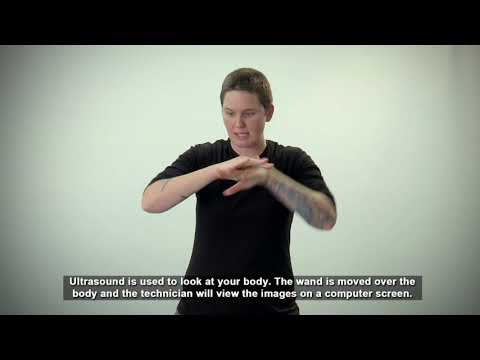
- Start with your dominant hand in a flat handshape (like the letter “B”).
- Position your hand slightly above your non-dominant hand, which should also be in a flat handshape, palms facing each other.
- Move your dominant hand in a circular motion over your non-dominant hand, mimicking the scanning motion of an ultrasound machine.
- Maintain a focused facial expression to convey the seriousness of the medical context.
- Finish the sign by bringing your dominant hand back to a resting position.
Common Mistakes
- Many learners forget to use facial expressions, which are crucial for conveying meaning in Auslan.
- Some use an incorrect handshape, which can lead to confusion with other signs.
- Not performing the circular motion correctly can make the sign unclear or misinterpreted.
Related Signs
- 1 – Represents the number one.
- 10 – Represents the number ten.
- 100 – Represents the number one hundred.
- 12 – Represents the number twelve.
- 15 – Represents the number fifteen.
Using “Ultrasound” in Everyday Conversations
In everyday conversations, the sign for “Ultrasound” can come up in various contexts, particularly when discussing health, pregnancy, or medical procedures. Here are a few example sentences that demonstrate how to use this sign naturally:
- “I had an ultrasound yesterday.”
- “The doctor said the ultrasound results are normal.”
- “She is excited to see the baby in the ultrasound.”
These sentences can arise during discussions about health appointments, sharing news about pregnancy, or talking about medical outcomes with family and friends.
Cultural Notes
The term “ultrasound” holds significant meaning within the Australian Deaf community, especially among those who are expecting or supporting loved ones through pregnancy. Ultrasounds are often shared experiences, accompanied by excitement and anticipation. In this context, the sign can foster a sense of community and shared understanding.
While Auslan is relatively uniform across Australia, there are subtle variations in signs and dialects between regions. For instance, some Northern Deaf communities may incorporate slight differences in handshape or facial expressions while signing “ultrasound”. Being aware of these regional differences can enrich your understanding and appreciation of Auslan as a living language.
Tips for Learning This Sign
Practicing the sign for “ultrasound” effectively can help solidify your memory and fluency. Here are some strategies to consider:
- Mirror Practice: Stand in front of a mirror while signing to observe your movements and ensure proper handshape and positioning.
- Focus on Non-Manual Features: Pay attention to facial expressions and body language that accompany the sign, as these features are crucial in conveying meaning.
- Incorporate into Short Sentences: Use the sign in simple sentences like “I went to the doctor for an ultrasound,” to help contextualize its usage.
Regular practice, especially with native Auslan users, will enhance your confidence and skills in using this sign effectively.
Frequently Asked Questions
How do I use “ultrasound” in a sentence?
You can say, “I have an ultrasound appointment tomorrow” by signing “I” + “have” + “ultrasound” + “appointment” + “tomorrow.”
Are there regional variations for this sign?
Yes, some regions may have slightly different signs or handshapes for “ultrasound,” so it’s helpful to learn from local Deaf community members.
What are some signs similar to “ultrasound”?
Signs like “scan,” “doctor,” or “baby” may be used in related contexts, but each has distinct movements.
How does this sign compare to its BSL equivalent?
While the concept is similar, the BSL sign may use different handshapes and movements, reflecting the unique aspects of British Sign Language.
What tips can help me teach this sign to others?
Demonstrate the sign clearly and encourage students to practice the movement and facial expression together for better retention.
Is “ultrasound” used in both medical and everyday contexts?
Primarily, “ultrasound” is used in medical contexts, but it can also be discussed in relation to baby showers or family gatherings when talking about pregnancy.
Practice This Sign
Try signing Ultrasound In Auslan with your camera and get AI coaching on your handshape, movement, and location.
Free · No signup required