
Auslan Interpreter Code of Ethics in Australian Sign Language (Auslan)

The sign for “Auslan Interpreter Code of Ethics” refers to the principles and standards guiding interpreters in the Deaf community, particularly within the context of Auslan (Australian Sign Language). This sign is commonly used in discussions about professionalism, ethical responsibilities, and the importance of maintaining confidentiality and respect for Deaf individuals during interpretation.
How to Sign “Auslan Interpreter Code Of Ethics”
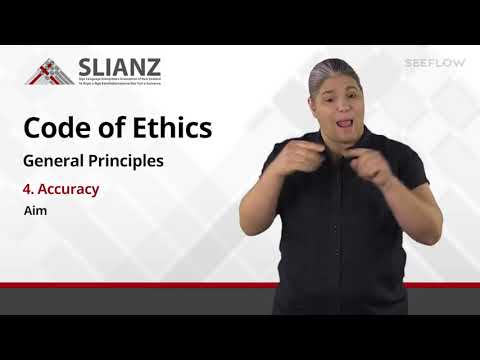
- Start with your dominant hand in a “C” shape, palm facing outward, and place it near your chin.
- Move your hand forward and slightly away from your face in a gentle arc, maintaining the “C” shape.
- Next, transition to the letter “I” by raising your dominant hand, keeping your thumb extended and fingers together, and hold it upright in front of you.
- For “Code,” form your non-dominant hand into a flat palm facing up, then place your dominant hand in a fist above it, and move it downward slightly, as if you are setting something down.
- Finally, for “Ethics,” use the dominant hand in a “5” shape and place it near your chest, then move it outward and away, emphasizing the importance of ethical standards.
Common Mistakes
- Forgetting to maintain facial expressions that indicate seriousness and professionalism, which are crucial in conveying the importance of the code.
- Incorrectly signing “Code” by not using the flat palm and instead using a fist throughout the sign.
- Omitting the transition between “Auslan” and “Interpreter,” which can lead to confusion in meaning.
Related Signs
- (Auslan) – The sign for Australian Sign Language.
- 1 – The sign for the number one, often used in various contexts.
- 10 – The sign for the number ten, useful in counting and discussions.
- 100 – The sign for one hundred, frequently used in financial contexts.
- 12 – The sign for the number twelve, useful in various scenarios.
Frequently Asked Questions
Can you use this sign in a sentence?
Yes! An example sentence would be: “The Auslan interpreter must follow the code of ethics.”
Are there regional variations for this sign?
No specific regional variations are known, but signs can differ depending on context and individual style.
What are some similar signs?
Similar signs include “Interpreting” and “Ethics,” which can be useful for discussing related topics.
How does this sign compare to BSL?
While there are similarities, BSL (British Sign Language) has its own unique signs and structures, so this sign may not directly translate.
What teaching tips can help with this sign?
Practice facial expressions and the flow between signs to convey professionalism and clarity in meaning.
Practice This Sign
Try signing Auslan Interpreter Code Of Ethics with your camera and get AI coaching on your handshape, movement, and location.
Free · No signup required