
Merci in LSF en Langue des Signes Française (LSF)
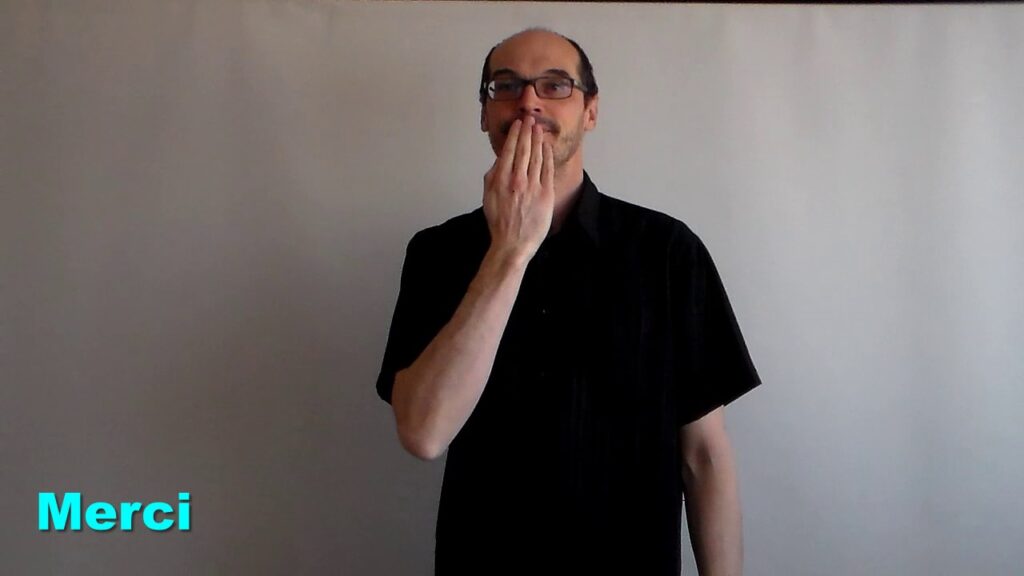
The sign for “merci” in LSF (Langue des Signes Française) expresses gratitude and appreciation. This sign is commonly used in everyday interactions to thank someone for their help or kindness. It is a fundamental part of polite communication within the Deaf community.
Table of Contents
How to Sign “Merci In Lsf”
- Start with your dominant hand open, fingers extended and together.
- Place the tips of your fingers on your chin, near your lower lip.
- Gently move your hand away from your face, extending your arm slightly forward.
- Maintain a friendly facial expression, showing warmth and sincerity as you sign.
Common Mistakes
- Using a flat hand instead of an open hand, which can distort the sign’s meaning.
- Moving the hand too far from the face, making it less clear that you are expressing gratitude.
- Neglecting facial expressions, which are vital for conveying emotion in sign language.
Related Signs
- 1 – Represents the number one in ASL.
- 1 Dollar – Indicates the value of one dollar.
- 10 – Signifies the number ten.
- 100 – Represents one hundred.
- 1000 In Lsf – Indicates the value of one thousand in LSF.
Frequently Asked Questions
How do I use “merci” in a sentence?
You can use “merci” to thank someone by saying, “Merci for helping me with my project!” while performing the sign.
Are there regional variations for this sign?
While “merci” is widely understood, some regions may have slight variations in movement or facial expressions.
What are similar signs to “merci”?
Similar signs include “thank you” and “appreciate,” which convey gratitude but might have different nuances.
How does this compare to BSL?
In BSL, the sign for “thank you” involves a similar motion but may have different hand shapes and facial expressions.
What are some tips for teaching this sign?
Encourage students to practice in pairs, focusing on facial expressions and the smoothness of the hand movement.
Practice This Sign
Try signing Merci In Lsf with your camera and get AI coaching on your handshape, movement, and location.
Free · No signup required