
Qualifications in British Sign Language (BSL)
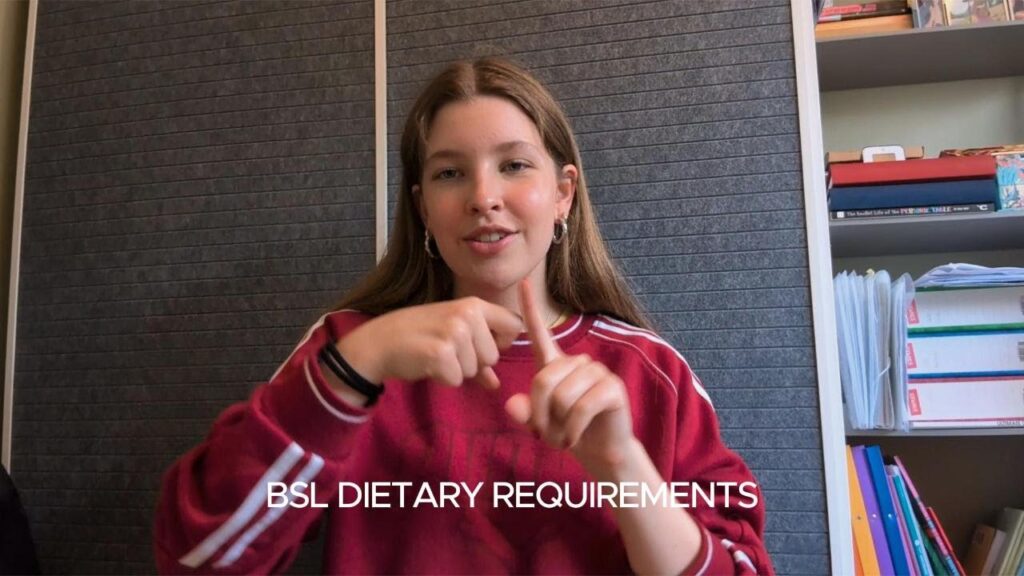
Indicating “British Sign Language qualifications” conveys the formal recognition of skills and knowledge in BSL. Commonly utilized in the UK Deaf community, this term arises in conversations about education, training, or achievements tied to BSL. It underscores the significance of accredited qualifications for individuals seeking professional roles within the Deaf community.
How to Sign “Qualifications” in BSL
- Start with your dominant hand in a flat “B” handshape, palm facing down.
- Position your hand at the side of your forehead, near your temple.
- Move your hand outwards and slightly upwards, maintaining the “B” shape.
- As you make this movement, raise your eyebrows to indicate a question or emphasis, showing the importance of the qualifications.
- To show that these qualifications relate to BSL, you can follow this sign by using the sign for BSL, which involves making the letter “B” followed by the sign for “Language.”
Common Mistakes
- Forgetting to use the correct handshape, often confusing it with a flat “A” handshape.
- Not incorporating the appropriate non-manual features, such as facial expressions, which convey emphasis.
- Using the wrong signing space, which can lead to confusion about the topic being discussed.
BSL vs ASL
In BSL, the sign for “qualifications” is distinct, using a flat handshape with a specific movement. In contrast, American Sign Language (ASL) may use a different handshape and movement, often incorporating more variations based on context. This highlights the unique grammar and structure of each sign language.
Related Signs
- Education – Referring to the process of receiving instruction.
- Training – Signifying the act of preparing for a particular skill or job.
- Deaf – Referring to the identity within the Deaf community.
- Skill – Indicating the ability or proficiency in a particular area.
Frequently Asked Questions
How can I use “qualifications” in a BSL sentence?
You can say, “I have BSL qualifications,” by signing “I” + “HAVE” + “QUALIFICATIONS” + “BSL.”
Are there regional variations for this sign?
Yes, some regional signs may differ slightly in movement or facial expression, but the basic structure remains consistent across the UK.
What are some similar signs to “qualifications”?
Similar signs include “education,” “training,” and “skill,” which all relate to learning and expertise.
What tips do you have for learning this sign?
Practice in front of a mirror to observe your handshape and facial expressions. Also, watch videos of native signers for additional context.
Can I use this sign in formal settings?
Absolutely, using the correct sign for qualifications is important in formal contexts such as educational discussions or job interviews.
How do I know if I’m using the sign correctly?
Seek feedback from fluent BSL users or instructors, and record yourself to compare your sign with video demonstrations.
Practice ASL Signs
Use your camera to practice signs and get real-time AI feedback on your technique.
Free · No signup required