
Job in British Sign Language (BSL)

The sign for “job” in British Sign Language (BSL) is commonly used when discussing employment, work roles, or tasks. It’s an important term within the UK Deaf community, particularly when talking about career opportunities or professional experiences.
How to Sign “Job” in BSL
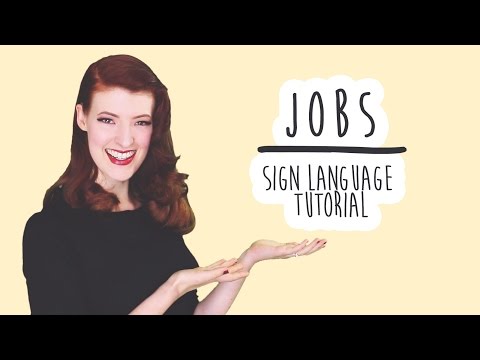
- Start with your dominant hand in a flat handshape (like a “B” handshape) and position it near your forehead.
- Move your hand away from your forehead in a forward arc, while keeping the palm facing outwards.
- As you perform this movement, incorporate a slight facial expression that indicates inquiry or curiosity, to enhance the meaning.
- For the “in BSL” part, use your non-dominant hand, forming a flat handshape and placing it in front of your body. Then, bring your dominant hand down onto your non-dominant hand to signify the concept of “in”.
Common Mistakes
- Focusing too much on hand movement without incorporating facial expressions can lead to misunderstandings. Remember to use your face to convey the right emotions.
- Using the incorrect handshape, such as a fist instead of a flat hand, can change the meaning of the sign.
- Forgetting to establish the context or topic-comment structure can make the sign unclear. Ensure that you focus on the topic first, then the comment.
BSL vs ASL
In American Sign Language (ASL), the sign for “job” looks quite different. ASL uses a single motion from the chin, indicating a work role or position, while BSL incorporates more movement and uses the facial expressions as part of the grammar. This difference highlights the unique characteristics of each sign language.
Related Signs
- (Bsl – A sign referring to the language itself.
- 1 – The sign for the number one, useful in various contexts.
- 10 – The sign for the number ten, often used in counting.
- 100 – The sign for one hundred, helpful in financial discussions.
- 12 – The sign for the number twelve, useful in various contexts.
Frequently Asked Questions
How do I use “job” in a BSL sentence?
You can structure it using the topic-comment format. For example, “Job I want” would be signed by emphasizing “job” first, followed by your desire or intention.
Are there regional variations in signing “job” across the UK?
While the basic sign remains consistent, some regions may have slight variations in movement or facial expressions. It’s best to learn from local Deaf communities.
What are some similar signs to “job”?
Signs like “work”, “career”, and “task” are related and can be used in similar contexts.
What tips can help me learn this sign effectively?
Practice with a partner or in a group to receive feedback. Also, watching videos of native signers can help you grasp the nuances.
Can I use “job” in a professional setting?
Absolutely! It’s a key term in discussions about employment and can be used in job interviews or networking events.
How do I indicate different types of jobs?
You can specify by adding signs for specific professions after “job,” such as “teacher job” or “nurse job” to clarify your meaning.
Practice ASL Signs
Use your camera to practice signs and get real-time AI feedback on your technique.
Free · No signup required