
Background in British Sign Language (BSL)
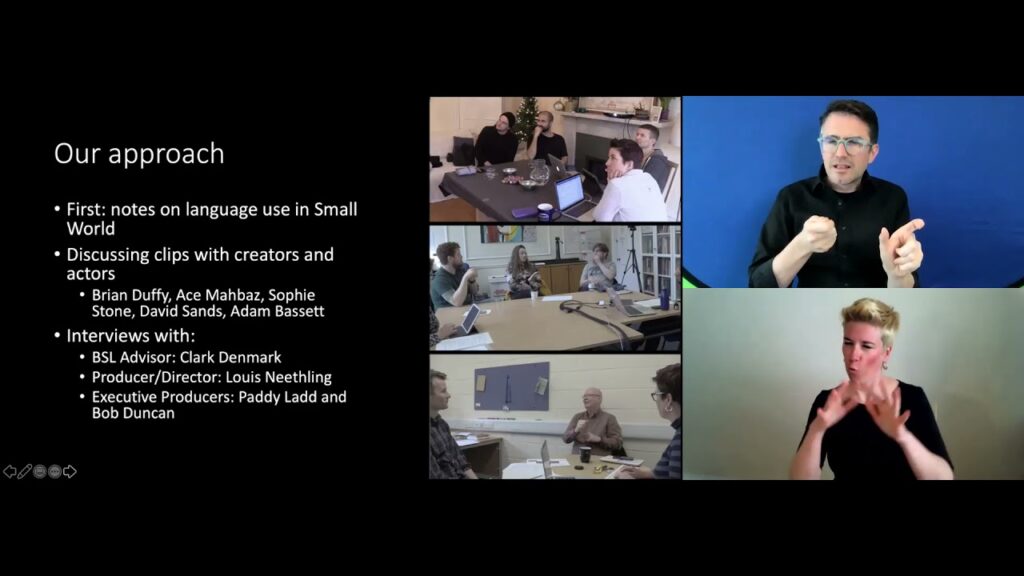
The sign “background in BSL” is used to describe someone’s experience or qualifications in British Sign Language. This sign is commonly used in conversations about education, work, or personal achievements within the UK Deaf community, particularly when discussing BSL teaching or interpreting roles.
How to Sign “Background” in BSL
- Start with your dominant hand in a flat ‘B’ shape (with fingers together and palm facing down) to represent “background.” Position this hand slightly to the side, just above your shoulder.
- Next, bring your non-dominant hand in a ‘B’ shape and place it directly in front of the dominant hand, palm facing your body. This indicates the context of BSL.
- Move both hands slightly outward and away from your body to show the concept of “background.” Make sure your facial expression is neutral yet engaged, reflecting the importance of the sign.
- Remember to use space effectively; if you’re talking about someone specific, you can point to that location in the signing space to clarify who you’re referring to.
Common Mistakes
- Confusing the hand shapes: Ensure you use the correct ‘B’ shape for both hands.
- Not using facial expressions: Remember that non-manual features, like eyebrow positioning, enhance the meaning of the sign.
- Neglecting the space: Be mindful of where you position your hands to avoid ambiguity in who or what you are referencing.
BSL vs ASL
In BSL, the sign for “background in BSL” uses specific handshapes and a clear representation of context, while in ASL, the sign may differ significantly in structure and movement. ASL often incorporates more iconic movements that may not directly translate to BSL, highlighting unique cultural expressions.
Related Signs
- Education – Sign for learning and teaching.
- Deaf – Referring to the Deaf community.
- Sign Language – General term for all sign languages.
- Teacher – Sign for someone who teaches.
- Communication – Referring to the exchange of information.
Frequently Asked Questions
How can I use “background in BSL” in a sentence?
You might say, “My background in BSL is strong,” using the sign to describe your own experience.
Are there regional variations for this sign across the UK?
While the sign is generally consistent, some regions may have slight variations in the handshape or movement based on local dialects.
What similar signs should I learn?
Learning signs like “Deaf” and “Education” can provide context and depth when discussing your background in BSL.
What are some tips for learning this sign?
Practice in front of a mirror, focusing on your hand shape and facial expressions to ensure clarity and accuracy.
Can I use this sign in a formal setting?
Yes, it’s appropriate in both formal and informal settings, especially when discussing qualifications or experiences.
Is this sign different for other sign languages?
Yes, other sign languages like ASL have their own unique signs and structures, so it’s essential to learn the specific signs for the language you are using.
Practice ASL Signs
Use your camera to practice signs and get real-time AI feedback on your technique.
Free · No signup required