
Baby Buggy in British Sign Language (BSL)

In the UK Deaf community, “baby buggy” denotes a baby stroller or carriage, serving as a practical term in discussions about parenting, outings with children, or various baby-related subjects. This expressive sign embodies aspects of British Sign Language grammar, making it vital for effective communication.
How to Sign “Baby Buggy”
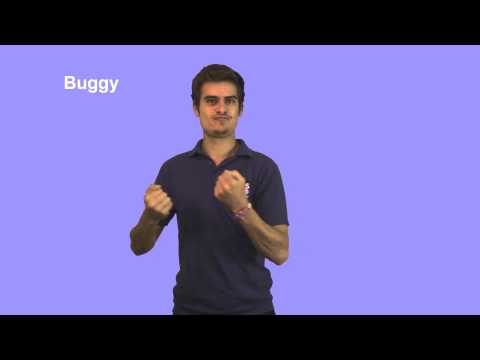
- Start with your dominant hand in a flat handshape (like a ‘B’ handshape) with fingers extended and together.
- Position your hand at waist level, slightly in front of your body, as if holding the handle of a buggy.
- Using a smooth motion, move your hand forward and slightly downwards, mimicking the motion of pushing a buggy.
- As you perform this movement, keep a relaxed facial expression. You can raise your eyebrows slightly to indicate that you are talking about a baby buggy.
Common Mistakes
- Some learners may confuse the sign for “baby buggy” with “baby,” using a more static handshape instead of the moving ‘B’ handshape.
- Not incorporating non-manual features, such as facial expressions, can make the sign less clear.
- Using too much or too little movement can lead to misunderstanding; the sign should be fluid and natural to convey the action of pushing.
BSL vs ASL
In British Sign Language, the sign for “baby buggy” focuses on the action of pushing, using a flat handshape. In American Sign Language (ASL), the sign might look different, potentially using a different handshape or movement. This highlights the unique aspects of each sign language and the importance of learning signs in their cultural context.
Related Signs
- Baby – The sign for a young child or infant.
- Child – A sign used to refer to a young person or offspring.
- Parent – The sign indicating a mother or father.
- Stroller – Another term for a baby buggy, often used interchangeably.
- Family – A sign representing the concept of family, which often includes babies and children.
Frequently Asked Questions
How can I use “baby buggy” in a BSL sentence?
You could say, “I am taking the baby buggy to the park,” by signing the action of taking, followed by the sign for “baby buggy,” and finishing with “park.”
Are there regional variations for this sign in the UK?
While the sign for “baby buggy” is generally consistent, some regions may have slight variations in how the movement is performed. It’s always good to observe local signers.
What are some similar signs to “baby buggy”?
Related signs include “stroller,” “pram,” and “baby,” all of which pertain to infants and their transportation.
What tips can you share for learning this sign?
Practice in front of a mirror to ensure your handshape and movement are correct. Watching native signers can also help reinforce the proper use of the sign.
Can this sign be used in different contexts?
Yes, the sign can be adapted depending on the context, such as emphasizing the act of pushing when discussing outdoor activities with a child.
Is there a specific facial expression I should use?
Using a relaxed and friendly expression while signing will help convey the meaning more effectively. Raising your eyebrows slightly can indicate that you are discussing a topic.
Practice ASL Signs
Use your camera to practice signs and get real-time AI feedback on your technique.
Free · No signup required