
Objection in Australian Sign Language (Auslan)
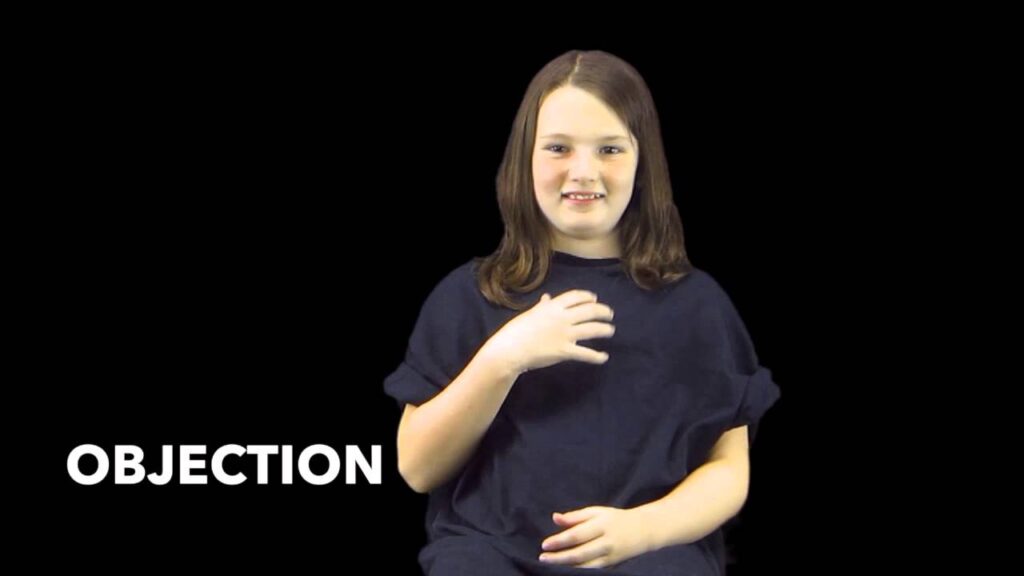
The sign for “objection” in Auslan is used to express disagreement or disapproval, often in discussions or debates. This sign is important in legal contexts or any situation where one might want to voice a differing opinion. It shows assertiveness and clarity in communication.
Table of Contents
How to Sign “Objection”
- Start with your dominant hand in a flat “B” handshape (palm facing down).
- Position your hand near your chest, with the fingers pointing to the left side of your body.
- Move your hand outward and slightly upward, away from your body, while maintaining the “B” handshape.
- As you make this movement, furrow your brow slightly to indicate seriousness or emphasis.
- Finish the movement with a confident and assertive expression to convey your objection clearly.
Common Mistakes
- Using an incorrect handshape, such as a fist instead of a flat hand.
- Positioning the hand too low or too far from the body, which can diminish the impact of the sign.
- Neglecting facial expressions, which are crucial for conveying the intensity of the objection.
Related Signs
- 1 – Sign for the number one.
- 1 Dollar – Sign representing a single dollar.
- 10 – Sign for the number ten.
- 100 – Sign for the number one hundred.
- 11 – Sign for the number eleven.
Using “Objection” in Everyday Conversations
The sign “Objection” can be used in various contexts beyond legal situations. Here are a few examples of how it might appear in everyday conversations:
- Example 1: “I have an objection to that idea.” (sign: “I” + “HAVE” + “OBJECTION” + “THAT” + “IDEA”)
- Example 2: “They raised an objection during the meeting.” (sign: “THEY” + “RAISED” + “OBJECTION” + “DURING” + “MEETING”)
- Example 3: “Can I express my objection?” (sign: “CAN” + “I” + “EXPRESS” + “MY” + “OBJECTION”)
These examples illustrate how the sign can be naturally integrated into discussions about opinions, disagreements, or decisions in both formal and informal settings.
Cultural Notes
The sign “Objection” holds significance within the Australian Deaf community, especially in contexts related to advocacy and social justice. Deaf individuals often use this sign to express dissent or disagreement in discussions about rights, accessibility, and inclusion. It reflects a broader cultural engagement with issues that impact the Deaf community.
In terms of dialect variation, while “Objection” is generally consistent across regions, some Northern and Southern Auslan users may have slight variations in handshape or movement. It’s beneficial to connect with local Deaf groups to observe and practice these nuances in real conversations.
Tips for Learning This Sign
Practising the sign “Objection” can be made easier with these techniques:
- Mirror Practice: Stand in front of a mirror while signing. This helps you check your handshape and movements, ensuring you’re correctly mimicking the sign.
- Pay Attention to Non-Manual Features: Observe the facial expressions and body language that accompany the sign. These non-manual features enhance meaning and convey the emotional weight of the objection.
- Use in Short Sentences: Create simple sentences incorporating “Objection” and practice them in context. This will help reinforce the sign and its usage in conversation.
Regular practice with these methods can help solidify your understanding and use of “Objection” in Auslan.
Frequently Asked Questions
How do I use “objection” in a sentence?
You can use it like this: “I object to that idea,” signing “I” followed by “objection.”
Are there regional variations for this sign?
Yes, some regions may have slight variations in movement or handshape. It’s always a good idea to learn from local Deaf communities.
What signs are similar to “objection”?
Signs like “disagree” or “no” can convey similar meanings but may differ in usage and nuance.
How does “objection” compare to BSL?
In BSL, the sign for “objection” may differ in movement and handshape, reflecting different linguistic structures.
What are some tips for teaching this sign?
Encourage students to practice facial expressions and emphasize the movement to convey the sign’s meaning effectively.
Practice This Sign
Try signing Objection In Auslan with your camera and get AI coaching on your handshape, movement, and location.
Free · No signup required