
Think in Sign Language (ASL)
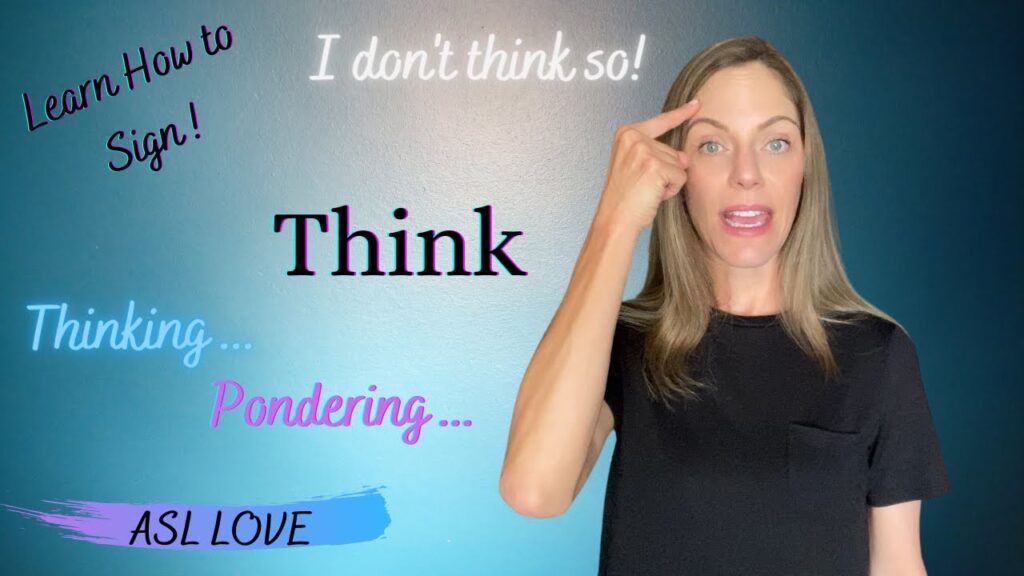
The sign “Think” is commonly used in American Sign Language (ASL) to express the act of considering, pondering, or reflecting on something. It conveys cognitive processes and often appears in conversations where thoughts or ideas are being shared or evaluated.
[VIDEO_PLACEHOLDER]
Table of Contents
Forming the sign
- Handshape: Use a closed fist with the thumb extended and positioned against your forehead.
- Location: The hand should start at the forehead, near the temple area.
- Movement: Move the hand outward slightly from the forehead, maintaining the closed fist shape.
- Non-manual signals: You may raise your eyebrows slightly to indicate contemplation or engagement with the thought.
To perform the sign “Think,” start by shaping your dominant hand into a fist, with the thumb extended. Place this fist against your forehead, and then move it away slightly while keeping the hand shape intact. The movement symbolizes the act of pulling an idea or thought from your mind. Employing a raised eyebrow adds a layer of expression, emphasizing the process of thinking.
Using “Think” in sentences
In conversations, the sign “Think” can be incorporated in various contexts. For example:
– “I think it will rain today” can be signed as “I THINK RAIN TODAY.”
– “Do you think she will join us?” translates to “YOU THINK SHE JOIN US?”
Using “Think” effectively conveys your opinion or belief, facilitating deeper discussions and engagement with others.
Signs related to “Think”
To enhance your communication, consider these related signs:
– Idea: Represents a concept or thought.
– Believe: Expresses faith or conviction in something.
– Know: Indicates awareness or understanding of information.
– Consider: Suggests pondering over an option or thought.
– Remind: Used to cue someone about a thought or obligation.
Common confusion with a similar sign
Many learners often confuse the sign “Think” with the sign for “Feel.” While both involve cognitive aspects, “Think” focuses on reasoning and contemplation, whereas “Feel” pertains to emotions and sensations. To differentiate, remember that “Think” has a more pronounced outward movement from the forehead, while “Feel” involves a more gentle touch or gesture that reflects emotional states.
FAQ
What is the difference between “Think” and “Consider”?
While both signs convey a mental process, “Think” emphasizes the act of reflecting or pondering, whereas “Consider” suggests weighing options or possibilities more actively.
Can “Think” be used in different tenses?
Yes, you can indicate different tenses by changing your facial expressions or by adding context to the sentence. For instance, past thoughts may be conveyed with a thoughtful furrowed brow.
How can I improve my use of “Think” in conversation?
Practice incorporating “Think” into sentences during casual conversations. Engaging with others and asking their thoughts can help solidify your understanding and usage.
Is there a regional variation for “Think” in ASL?
The sign is generally consistent across regions, but as with many signs, individual delivery may vary slightly based on personal or regional styles.
Practice ASL Signs
Use your camera to practice signs and get real-time AI feedback on your technique.
Free · No signup required