
Remind in Sign Language (ASL)
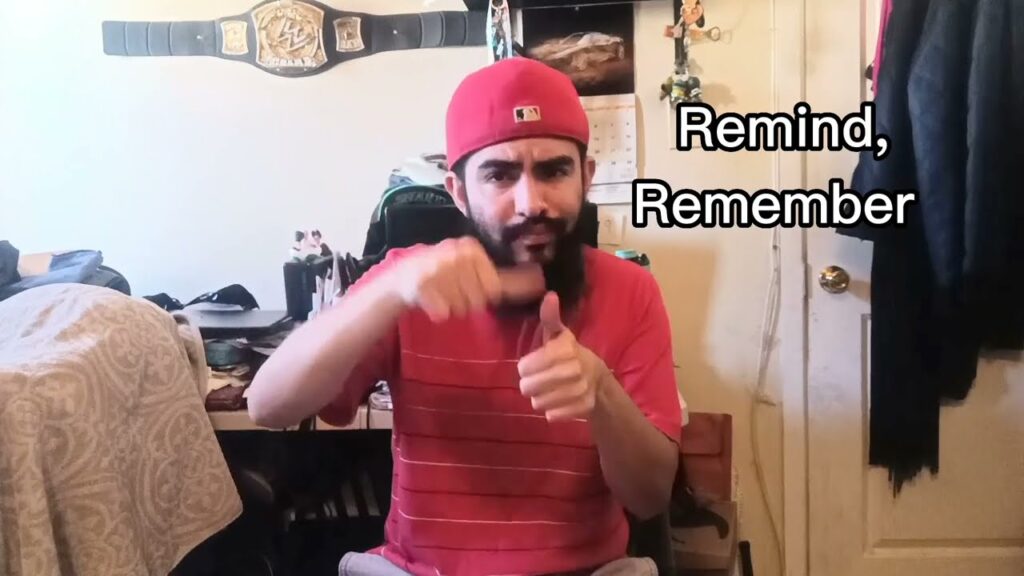
Remind is a versatile sign used to indicate the action of prompting someone to remember or recall something. This sign is commonly employed in conversations to help someone remember important information, tasks, or events. It serves as a helpful tool in communication, enabling individuals to express the need to jog someone’s memory.
[VIDEO_PLACEHOLDER]
Table of Contents
Forming the sign
- Handshape: Use your dominant hand to form the letter “R.” The thumb and the index finger should be extended while the other fingers are folded down.
- Location: Position your hand near your forehead, specifically at the temple area. This is the typical starting point for the sign.
- Movement: From the starting position, move your hand forward in a slight arc away from your head. The motion should be fluid and gentle, maintaining the “R” handshape throughout.
- Non-manual signals: Incorporate facial expressions that indicate querying or prompting. A raised eyebrow can signal the importance of the reminder being given.
The sign for remind effectively conveys the action of recalling or prompting a memory. The placement near the head symbolizes the act of bringing thoughts to the forefront of one’s mind. Utilizing appropriate facial expressions can enhance the meaning and urgency behind the sign, making it more effective in communication.
Showing tense, aspect & repetition
To indicate different tenses or aspects when using the sign remind, subtle changes in movement and context can be applied. For instance, to show that someone is currently reminding another person about something, you would perform the sign in a steady, continuous manner. If you wish to convey that you reminded someone in the past, you might emphasize the movement by making it slightly slower and more pronounced. Additionally, to highlight repetition, you can perform the sign multiple times in succession, indicating that reminders are being given more than once.
“Remind” in everyday signing
In daily conversations, remind can be incorporated in various contexts. For example, you might say, “I need to remind you to submit your homework,” demonstrating the practical use of the sign in educational settings. Alternatively, you could use it in a personal context, such as “I remind you of our dinner plans later.” This sign is particularly useful in settings where memory is crucial, such as reminding friends about appointments, deadlines, or important dates.
Mistakes to avoid
When signing remind, there are common mistakes to be aware of to ensure clarity in communication. One frequent error is using an incorrect handshape; some learners may inadvertently use a flat hand instead of the proper “R” handshape. Another mistake is rushing the sign, which can lead to misunderstandings about the importance of the reminder. Remember to maintain eye contact and appropriate facial expressions, as these non-manual signals provide additional contextual clues that enhance comprehension.
Common confusion with a similar sign
Many learners confuse the sign for remind with the sign for help. While both signs involve hand movements near the head, the handshape and intent are different. Remind uses the “R” handshape to indicate prompting memory, while help uses an open handshape to signify assistance. Being aware of these distinctions can prevent misunderstandings and ensure that your communication accurately reflects your intentions.
FAQ
What is the difference between remind and remind me?
The sign for remind can be used in both contexts, but when you add “me,” you typically indicate who is being prompted. This adds clarity to the conversation.
Can remind be used in a question?
Yes, you can ask someone if they need a reminder by combining the sign with appropriate facial expressions, such as raising your eyebrows and tilting your head slightly.
Is there a specific way to sign remind for different situations?
Yes, the context of the conversation can influence how you perform the sign. For instance, using a more urgent movement if the reminder is time-sensitive can convey the necessary urgency.
Are there regional variations of the sign remind?
While the basic structure remains the same, some variations may exist based on local Deaf communities. It’s helpful to learn from native signers in your area.
Practice ASL Signs
Use your camera to practice signs and get real-time AI feedback on your technique.
Free · No signup required