
Help in Sign Language (ASL)
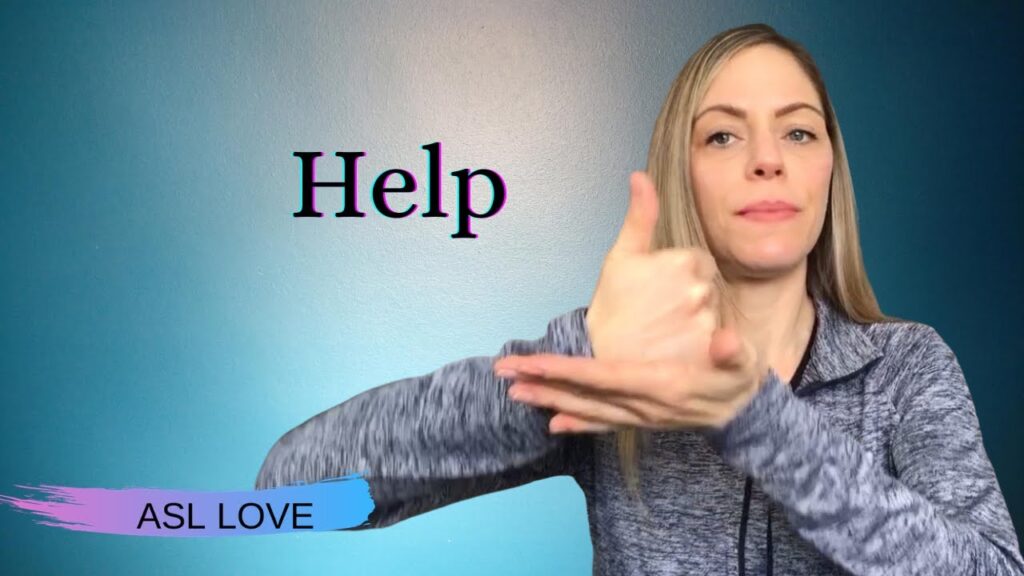
The sign Help is widely used in American Sign Language to indicate assistance or support. It can refer to both the act of helping someone and the need for help. This sign is frequently employed in various contexts, from personal conversations to more formal situations where assistance is required.
[VIDEO_PLACEHOLDER]
Table of Contents
Forming the sign
- Handshape: Start with both hands in a flat “B” handshape. The dominant hand should be on top, while the non-dominant hand remains stationary.
- Location: Position your dominant hand over the non-dominant hand, usually around the center of your chest area.
- Movement: Move your dominant hand slightly upward, lifting it away from the non-dominant hand as if offering help. This upward motion signifies the act of providing assistance.
- Non-manual signals: Accompanying facial expressions can enhance the meaning of the sign. A concerned or supportive facial expression can indicate a more serious request for help.
When forming the sign Help, remember that the upward movement signifies a willingness to assist. This gesture is often used in both casual and urgent scenarios, making it an essential part of everyday communication in the Deaf community.
Showing tense, aspect & repetition
In ASL, verbs can convey tense and aspect through specific movements or repetitions. The sign Help can be modified for tense by adjusting the movement. For example, a single upward motion can indicate a simple request for help, while repeated movements can suggest ongoing assistance or a more urgent need. For instance, if you need immediate help multiple times, you can repeat the upward motion, making it clear that the assistance is required urgently.
To express past tense, you can use a backward movement as you perform the sign, indicating that help was given previously. This flexibility in movement allows for rich storytelling and clear communication about assistance in various contexts.
“Help” in everyday signing
The sign Help is commonly used in everyday conversations among Deaf individuals. You might use it in various scenarios, such as asking a friend for assistance with a task or offering your support to someone in need. For example, if you see someone struggling to carry an object, you might sign Help to indicate that you are willing to assist them.
Additionally, Help can be combined with other signs to create phrases like “Can you help me?” or “I need help.” These combinations enhance the clarity of your message and encourage more detailed interaction. Understanding how to incorporate Help into your conversations will significantly improve your ASL fluency.
Mistakes to avoid
When learning the sign Help, it’s essential to avoid a few common pitfalls. One mistake is using an incorrect handshape; ensure that both hands are in a flat “B” shape to convey the correct meaning. Another mistake is performing the sign too quickly or without sufficient movement. The upward motion should be clear to effectively communicate the action of helping.
Additionally, it’s important not to overlook non-manual signals. Failing to incorporate appropriate facial expressions can lead to misunderstandings about the seriousness of the help being requested or offered. Take your time to practice these elements until they become a natural part of your signing.
Signs related to “Help”
There are several related signs that can complement your use of Help. Here are a few:
- Assist: Similar to Help but often implies a more formal or structured type of assistance.
- Support: Indicates backing or encouragement, often used in emotional contexts.
- Need: Expresses a necessity, often used in conjunction with Help to clarify the urgency of the request.
- Please: A polite way to ask for Help, emphasizing the request’s courteous nature.
Common confusion with a similar sign
Many learners confuse the sign Help with the sign for “show” or “teach.” While both involve a similar handshape and movement, the context and accompanying facial expressions will distinguish them. Help expresses a supportive action, while “show” or “teach” conveys the act of demonstrating or instructing. Paying attention to the context in which you use these signs can help prevent miscommunication.
FAQ
What is the difference between the signs for “Help” and “Support”?
The sign for Help is more direct and indicates a request for assistance, while Support often implies emotional backing or encouragement.
Can Help be used in various contexts?
Yes, Help is versatile and can be used in personal conversations, during emergencies, or in formal situations where assistance is needed.
Is it necessary to use facial expressions with the sign Help?
Yes, facial expressions enhance the meaning of the sign and convey the urgency or seriousness of your request or offer for assistance.
How can I practice the sign Help effectively?
You can practice by incorporating the sign into everyday conversations, using it in context with other signs, and paying attention to your facial expressions.
How does the movement of Help differ for past tense?
To indicate past tense, perform the sign with a backward movement, suggesting that assistance was provided previously.
Practice ASL Signs
Use your camera to practice signs and get real-time AI feedback on your technique.
Free · No signup required