
Assist in Sign Language (ASL)
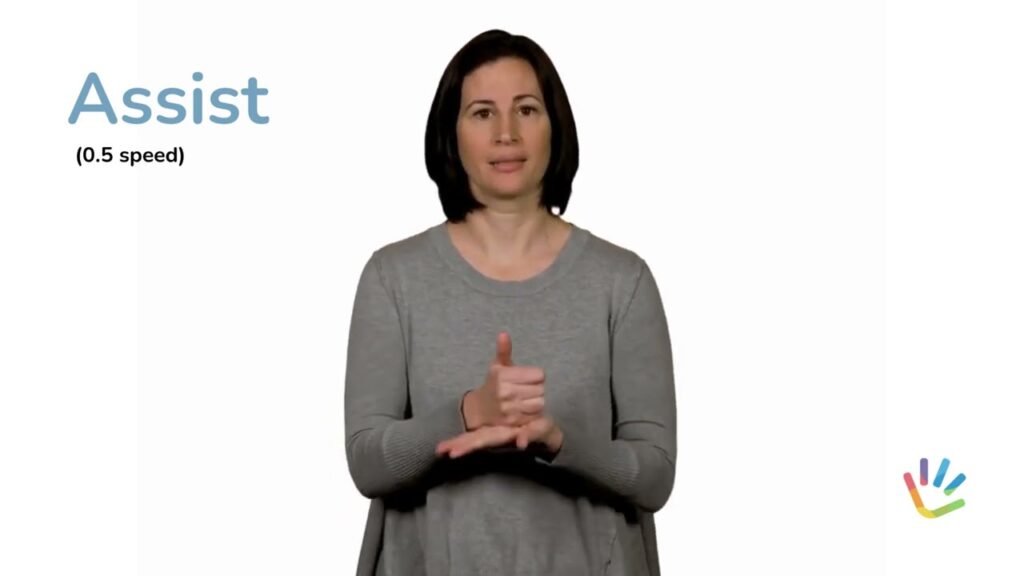
The sign “Assist” conveys the action of providing help or support to someone. It can be used in various contexts, such as offering assistance in tasks, guiding someone, or helping with decision-making. This sign is essential in both everyday conversations and more formal settings where collaboration is needed.
[VIDEO_PLACEHOLDER]
Table of Contents
Forming the sign
- Handshape: Start with a flat handshape, palm facing down. You can use your dominant hand to represent the action of assisting.
- Location: Position your dominant hand in front of your body, typically around chest height, which gives a clear indication of your intention to assist.
- Movement: The sign involves a gentle upward movement, as if you are lifting or elevating something. This motion symbolizes the act of providing support.
- Non-manual signals: You can enhance the sign by using facial expressions that convey kindness or willingness to help, such as a slight smile or raised eyebrows.
When signing “Assist,” it’s crucial to combine these elements smoothly to convey the action clearly. The upward movement represents the act of helping, while the facial expressions add an emotional layer, making your intention understood better.
Showing tense, aspect & repetition
In ASL, conveying the tense of “Assist” can be done through various methods such as the use of non-manual signals and repetition of the sign. To indicate present tense, simply perform the sign once. For past tense, a backward movement can be used in addition to the sign, suggesting that assistance was provided in the past. For future tense, you can point forward after signing to imply that assistance will occur later.
Repetition of the sign can emphasize the continuous nature of the assistance being provided. For example, if you are expressing ongoing support, you can repeat the sign while maintaining the same upward motion, indicating that help is still being offered.
“Assist” in everyday signing
Using “Assist” in sentences can create a clear and effective communication about support. For instance, you might sign: “I assist my friend with homework” or “Can you assist me with this task?” This makes your intentions clear to the person you are communicating with. Remember that context is key in ASL, so adjusting your facial expressions and body language helps convey the nuances of your message more effectively.
Common confusion with a similar sign
Beginners may confuse the sign “Assist” with the sign for “Help,” which has a different handshape and movement. While both signs aim to convey a sense of support, “Help” is often depicted with a dominant hand gripping a non-dominant hand, symbolizing a more direct form of assistance. In contrast, “Assist” has a broader and more abstract representation. Understanding these differences is crucial for clear communication.
FAQ
What is the difference between “Assist” and “Help”?
“Assist” is often more general and can imply support in various forms, while “Help” usually refers to more direct and immediate assistance.
Can “Assist” be used in both formal and informal settings?
Yes, “Assist” is versatile and can be used in both casual conversations and formal contexts, such as meetings or collaborative projects.
How do I sign “Assist” if I’m using both hands?
You can use both hands in a mirrored motion to emphasize collaboration, with each hand performing the “Assist” sign simultaneously. This might imply teamwork.
Is there a variation of the sign “Assist” in different regions?
While the core sign remains consistent, some regions may have slight variations in handshape or movement. It’s helpful to observe local signing to adapt accordingly.
Practice ASL Signs
Use your camera to practice signs and get real-time AI feedback on your technique.
Free · No signup required