
Couch in Sign Language (ASL)
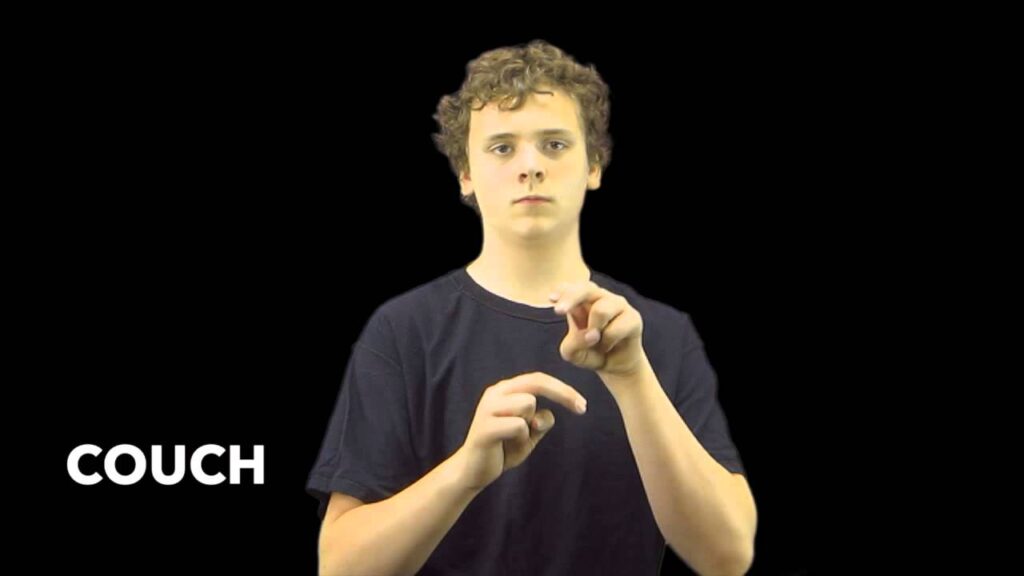
The sign for Couch represents the piece of furniture commonly found in living rooms where people sit, relax, and socialize. It is used in various contexts, such as discussing home decor, inviting someone to sit, or describing a comfortable space. Understanding how to sign Couch is essential for everyday conversations about home life.
[VIDEO_PLACEHOLDER]
Table of Contents
Forming the sign
- Handshape: Start with both hands open, fingers extended and together. Your dominant hand will form a flat “B” handshape, while your non-dominant hand remains in a flat position as well.
- Location: Position both hands in front of your body, approximately at waist level. This should be centered to your torso, as the signing space is typically personal and within reach.
- Movement: Move your dominant hand forward and slightly outward while keeping it flat. This motion mimics the idea of a couch being a surface you can sit on. You can also gently bounce your hand as if indicating the softness of the couch.
- Non-manual signals: You can enhance your sign with facial expressions. A relaxed smile can convey comfort, while a raised eyebrow can add emphasis, suggesting the couch is an inviting place.
When signing Couch, it’s essential to maintain a relaxed posture and ensure your hand movements are fluid. The sign is straightforward, so practice in front of a mirror to see how your expression matches the action.
Using “Couch” in sentences
In a sentence, you could say, “I love to relax on the couch after work.” To sign this, you would first sign “I”, then sign “love” (using your dominant hand over your heart), followed by “relax” (indicating a reclining position with your hands), and finally sign “couch.” Another example could be, “Let’s watch a movie on the couch,” where you would sign “Let’s” with a beckoning gesture, followed by “watch” (with your hands mimicking looking at a screen) and then ending with the couch sign.
Signs related to “Couch”
Here are some related signs that you may find useful:
- Sofa – Often used interchangeably, another type of seating furniture.
- Chair – A sign for another common piece of furniture that is typically smaller than a couch.
- Home – Related to the context of where a couch is usually found.
- Living Room – The area where a couch is commonly placed.
Where this sign comes from
The sign for Couch has its roots in the physical representation of a couch itself. The flat handshape and the forward motion mimic the surface and comfort of a typical couch. In early Deaf communities, furniture signs often developed in ways that related closely to the physical characteristics of the items they represented, leading to signs that are intuitive and easy to remember.
FAQ
What is the difference between a couch and a sofa?
In many contexts, there is no significant difference, and the terms are used interchangeably. However, some might consider a sofa to be slightly more formal than a couch.
Can I use the sign for Couch when referring to a loveseat?
Yes, while there may not be a specific sign for “loveseat,” you can use the sign for Couch and adjust your description verbally to specify the type of seating.
Is the sign for Couch the same in other sign languages?
Sign variations may exist between different regions and sign languages, so it’s always best to learn the specific signs used in the community you are engaging with.
How can I practice the sign for Couch effectively?
Practice in front of a mirror to check your handshape and facial expressions. You can also try signing in sentences or with a partner to enhance your comfort level.
Practice ASL Signs
Use your camera to practice signs and get real-time AI feedback on your technique.
Free · No signup required