
Ugly in British Sign Language (BSL)
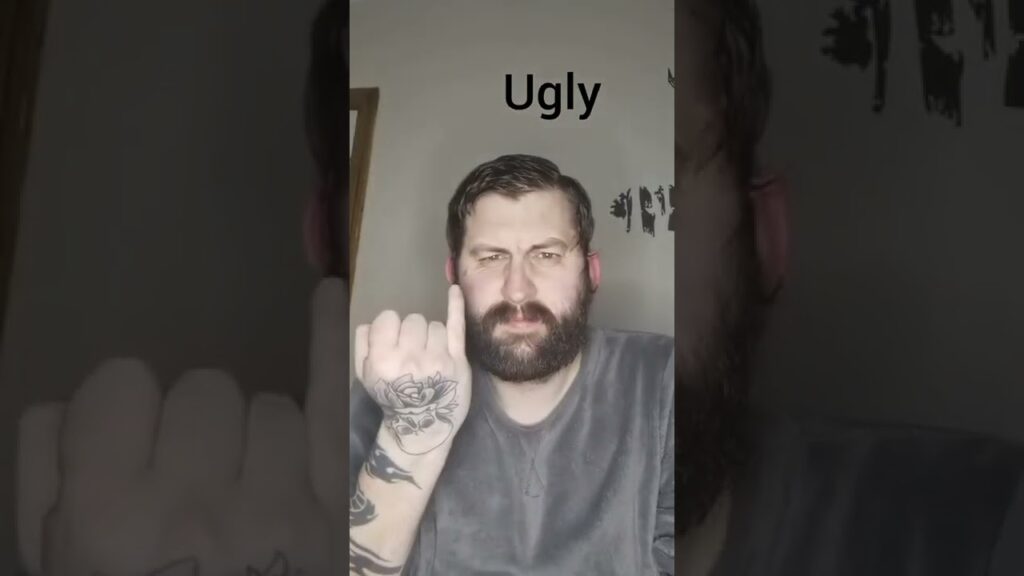
The sign for “ugly” in BSL is used to describe something that is not aesthetically pleasing or is unattractive. This sign can be used in various contexts, whether discussing appearances or expressing opinions about an artwork or object. It’s a straightforward sign that is part of everyday conversation in the UK Deaf community.
How to Sign “Ugly” in BSL

- Start with your dominant hand in a ‘5’ handshape. Your fingers should be spread apart.
- Position your hand in front of your face, approximately at eye level.
- Move your hand downwards in a slight arc while simultaneously closing your fingers into a ‘claw’ shape.
- As you perform the movement, scrunch up your facial expression to convey a sense of disgust or unattractiveness.
- End the sign with your hand at about chest level, palm facing down.
Common Mistakes
- Not using facial expressions: A common error is failing to show the appropriate facial expression, which adds meaning to the sign.
- Incorrect handshape: Some learners may forget to transition from a ‘5’ handshape to a ‘claw’ shape, which is crucial for conveying the sign’s meaning.
- Improper placement: Signing too low or too high can change the intended meaning, so ensure your hand is at the right level.
BSL vs ASL
In BSL, the sign for “ugly” is distinct from the ASL sign. While BSL uses a ‘5’ handshape transitioning to a ‘claw,’ ASL employs a different handshape and movement that focuses on the face. This highlights the unique features of each sign language and their cultural contexts.
Related Signs
- Beautiful – The opposite of ugly, used to describe attractive appearances.
- Pretty – Similar to beautiful, often used for less formal contexts.
- Good – A general positive sign, useful in various contexts.
- Nice – Often used to describe pleasant experiences or items.
- Fine – Another positive sign, commonly used in casual conversation.
Frequently Asked Questions
How can I use “ugly” in a BSL sentence?
You can use it as a comment on something you find unattractive, like “This painting is ugly” where “this painting” is the topic signed first, followed by the sign for ugly.
Are there regional variations for the sign “ugly”?
While the sign is generally consistent across the UK, some regions may have slight variations in movement or facial expressions, influenced by local dialects.
What are some similar signs to “ugly”?
Signs like “bad” or “disgusting” may convey similar feelings, but they are used in different contexts. Understanding these nuances can help in communication.
Any tips for learning this sign effectively?
Practice in front of a mirror to refine your handshape and facial expressions. Watching fluent signers and mimicking their signs can also be very helpful.
Can I use this sign in a positive context?
This sign is typically negative, so it’s not suitable for positive contexts. Always consider the sentiment you want to convey.
What should I do if I’m unsure about the sign?
If you’re unsure, don’t hesitate to ask a member of the Deaf community for clarification. Most Deaf individuals appreciate the effort to learn.
How can I improve my BSL vocabulary?
Regular practice, engaging with the Deaf community, and using online resources or classes can significantly enhance your vocabulary.
Practice ASL Signs
Use your camera to practice signs and get real-time AI feedback on your technique.
Free · No signup required