
Dark Blue Colour in British Sign Language (BSL)

“Dark blue” in British Sign Language (BSL) denotes the colour dark blue, frequently appearing in contexts such as fashion, art, or when describing various objects. Members of the UK Deaf community often utilize this sign in everyday conversation, particularly when engaging in discussions about colour preferences or choices.
How to Sign “Dark Blue Colour In Bsl” in BSL
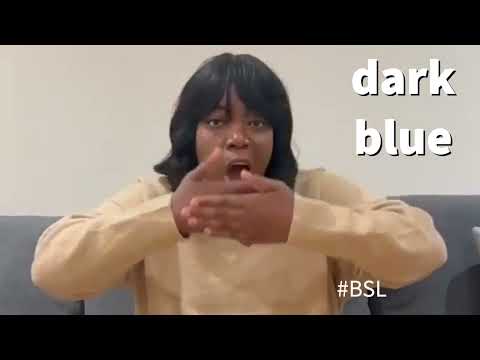
- Start with your dominant hand in a flat ‘B’ shape (fingers extended and together, thumb out). Position your hand in front of your chest.
- Move your hand slightly forward and down, maintaining the ‘B’ handshape throughout the movement.
- As you move your hand, slightly tilt your head forward and raise your eyebrows to indicate that you are signing about the colour.
- Finish the movement at about waist level, ensuring that your hand is stable before stopping.
Common Mistakes
- Forgetting to use the correct hand shape; some learners may use a flat hand instead of the ‘B’ shape.
- Not incorporating the appropriate facial expressions, which are crucial for conveying meaning in BSL.
- Moving the hand too quickly, making it difficult for others to understand the sign.
BSL vs ASL
In American Sign Language (ASL), the sign for “dark blue” differs in both handshape and movement. While BSL uses a flat ‘B’ handshape, ASL may use a different sign altogether, often incorporating more movement and a different hand position. This highlights the unique characteristics of each sign language.
Related Signs
- Light Blue – The sign for a lighter shade of blue.
- Blue – A general sign for the colour blue.
- Black – The sign for the colour black.
- Dark – The sign used to indicate darkness in colours.
- Colour – A sign used to refer to colours in general.
Frequently Asked Questions
How can I use “dark blue” in a BSL sentence?
You can say, “I like dark blue,” by signing “I” (pointing to yourself), followed by “like” (thumbs up), and then the sign for “dark blue.”
Are there regional variations for this sign in the UK?
While the sign is generally consistent, some regional variations may exist in the speed or emphasis of the movement.
What other signs are similar to “dark blue”?
Signs for other colours like “light blue” or “blue” are closely related and involve similar handshapes.
What tips do you have for learning this sign?
Practice in front of a mirror to ensure your handshape and movement are correct, and pay attention to your facial expressions.
Can I use “dark blue” in a conversation about fashion?
Yes, this sign is perfect for discussing clothing colours or preferences in fashion.
Is “dark blue” used differently in formal settings?
The sign remains the same; however, the context may change based on the formality of the conversation.
Practice ASL Signs
Use your camera to practice signs and get real-time AI feedback on your technique.
Free · No signup required