
Tactile in Australian Sign Language (Auslan)
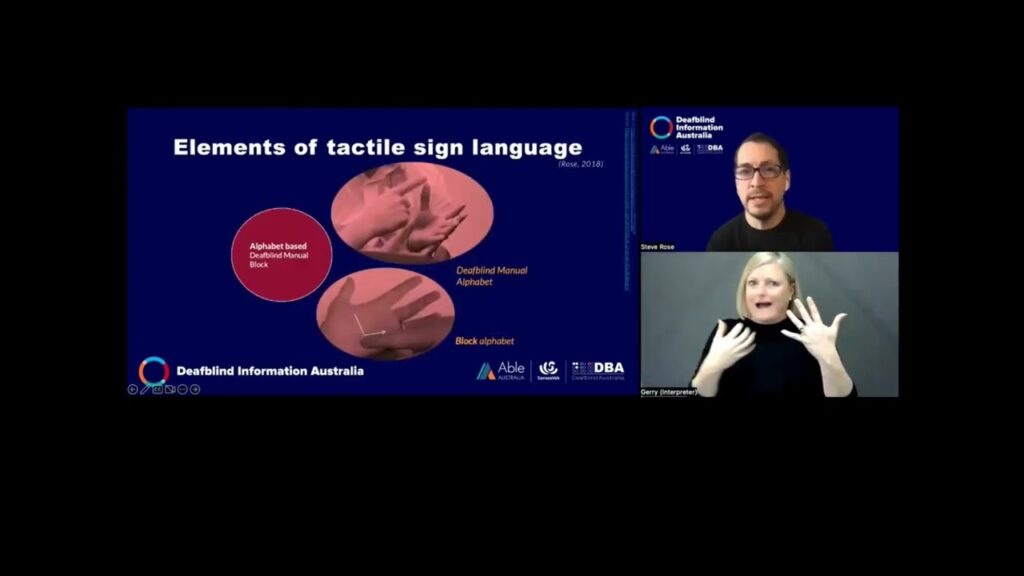
The sign “tactile in Auslan” refers to a communication method often used by individuals who are Deafblind, where information is conveyed through touch. This sign is essential in contexts where visual signs are not accessible, allowing for meaningful interaction through tactile feedback.
Table of Contents
How to Sign “Tactile”
- Begin with your dominant hand in a flat handshape (like a “B” handshape) with your palm facing down.
- Position your hand near the person’s hand or forearm, ensuring they can feel your movements.
- Lightly touch or trace the outline of the sign you want to communicate, maintaining a gentle and clear pressure.
- Make sure to maintain a relaxed and open facial expression to convey warmth and approachability.
Common Mistakes
- Using too much pressure when touching, which can be uncomfortable for the receiver.
- Not ensuring that the receiver’s hand is positioned correctly to feel the sign.
- Failing to maintain eye contact or appropriate facial expressions, which are crucial for effective communication.
Related Signs
- 1 – Represents the number one in ASL.
- 1 Dollar – Sign for one dollar, used in financial contexts.
- 10 – Represents the number ten in ASL.
- 100 – Sign for one hundred, often used in counting.
- 15 – Represents the number fifteen in ASL.
Using “Tactile” in Everyday Conversations
The sign “tactile” is often used in various contexts within the Deaf community. Here are a few example sentences to illustrate its use:
- “My friend is tactile with sign language.” – This might come up when discussing communication preferences of friends who are Deaf or hard of hearing, particularly those who benefit from tactile signing due to their individual needs.
- “The tactile method helps me understand better.” – This could be used in a conversation about teaching or learning experiences, emphasizing how tactile communication aids comprehension.
- “I feel more connected when we use tactile signs.” – This sentence could arise in discussions about social interactions, highlighting the importance of touch in establishing closeness and understanding within the Deaf community.
Cultural Notes
The concept of tactile communication holds significant cultural value in the Australian Deaf community, particularly for individuals who are Deafblind or have additional disabilities. Tactile signing often involves using touch to convey signs directly onto a person’s hands or body, facilitating a deeper connection and understanding.
In Australia, there can be variations in how tactile signing is approached between different regions. In northern areas, there may be a stronger emphasis on integrating tactile methods with Auslan, while southern regions might incorporate more traditional signing techniques. However, the core principle remains the same: fostering effective communication through touch.
Tips for Learning This Sign
To effectively learn and remember the sign “tactile,” consider the following strategies:
- Mirror Practice: Stand in front of a mirror to practice the sign. This will help you observe your own movements and ensure you are forming the sign correctly.
- Focus on Non-Manual Features: Pay attention to facial expressions and body language that accompany the sign, as these non-manual features are crucial for conveying meaning in Auslan.
- Incorporate in Short Sentences: Use “tactile” in simple sentences during practice sessions. For example, sign “I use tactile communication” in different contexts to reinforce your understanding and recall of the sign.
By embedding “tactile” into your everyday practice, you’ll become more comfortable with its use and significance in conversations.
Frequently Asked Questions
How would I use “tactile in Auslan” in a sentence?
You might say, “I use tactile signing when communicating with my friend who is Deafblind.”
Are there regional variations of this sign?
Yes, some regions may have slight variations in the way “tactile” is signed, so it’s important to observe and adapt to the local community.
Are there similar signs to “tactile”?
Yes, signs for communication methods like “finger-spelling” or “touch-signing” may be similar but have distinct motions.
How does this sign compare to BSL?
While BSL has its own signs for similar concepts, the tactile approach may vary in execution. Observing the differences can enhance understanding.
What teaching tips can help with this sign?
Practice with a partner to ensure proper pressure and clarity. Use a variety of tactile materials to demonstrate different signs.
Practice This Sign
Try signing Tactile In Auslan with your camera and get AI coaching on your handshape, movement, and location.
Free · No signup required