
Laminate in Australian Sign Language (Auslan)

The sign for “laminate” in Auslan refers to the process of covering a material with a protective layer, often used in contexts like education or crafts. It’s a practical sign commonly used when discussing documents, presentations, or any items that require durability and preservation.
Table of Contents
How to Sign “Laminate”
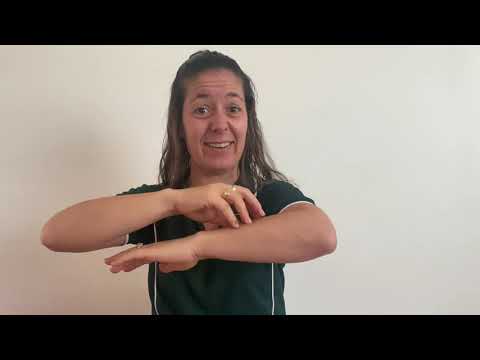
- Start with your dominant hand in a flat handshape, fingers together and palm facing down.
- Position your dominant hand above your non-dominant hand, which is also in a flat handshape, palm facing up.
- Move your dominant hand down towards the non-dominant hand, as if you are placing a layer over it.
- As you move your dominant hand down, slightly bend your elbows to emphasize the action of layering.
- Maintain a focused facial expression, indicating the action of covering or protecting.
Common Mistakes
- Forgetting to keep the handshapes flat; some learners might inadvertently curl their fingers.
- Not emphasizing the downward movement, which can make the sign unclear.
- Using a too quick motion that doesn’t convey the layering effect properly.
Related Signs
- 1 – The number one in ASL, often used in counting or indicating a single item.
- 1 Dollar – The sign for one dollar, helpful in financial contexts.
- 10 – The number ten in ASL, used in counting or numerical discussions.
- 100 – The sign for one hundred, useful in various contexts.
- 1 – The basic sign for one, foundational in learning numbers in ASL.
Using “Laminate” in Everyday Conversations
In daily interactions, the sign “Laminate” can come up in various contexts, particularly when discussing materials, crafts, or presentations. Here are a few example sentences that illustrate how to incorporate this sign into everyday conversations:
- “I want to laminate these documents for protection.”
This sentence might arise during a discussion about preparing important papers or school assignments.
- “Can you help me laminate my art project?”
This could come up in a setting where someone is working on a creative piece and wants to preserve it.
- “We should laminate the schedule so it lasts longer.”
This is a common topic when planning events or creating materials that need to be durable.
Cultural Notes
In the Australian Deaf community, the act of laminating materials is often associated with promoting accessibility and preserving visual aids used in education and communication. The practice of laminating is seen as a way to enhance the longevity of important resources, whether they are classroom materials or personal projects. It’s also common for Deaf community members to collaborate on projects that require the use of laminated materials, especially in workshops or community events.
While “Laminate” is generally understood across Australia, some regional variations in Auslan may exist. For instance, this sign might be expressed with slight differences in handshape or movement between Northern and Southern dialects. Being aware of these variations can enrich your understanding and communication with diverse members of the Deaf community.
Tips for Learning This Sign
To effectively learn and remember the sign “Laminate,” consider the following practical tips:
- Mirror Practice: Stand in front of a mirror while practicing the sign. This helps you observe your movements and ensure they match the correct form.
- Non-manual Features: Pay close attention to facial expressions and body language while signing. These non-manual features can add meaning and context to the sign.
- Use in Short Sentences: Incorporate “Laminate” into simple phrases or sentences during practice. This helps reinforce your understanding and makes the sign feel more natural in conversation.
Regular practice and engagement with the Deaf community will further enhance your skills and confidence in using the sign “Laminate.”
Frequently Asked Questions
How can I use “laminate” in a sentence?
You might say, “I need to laminate this important document,” using the sign to emphasize the action.
Are there regional variations of this sign?
While the core sign remains the same, some regions may have slight variations in hand movement or facial expression.
What’s a similar sign to “laminate”?
The sign for “cover” could be considered similar, as it also involves placing one hand over another.
How does this sign compare to BSL?
The sign for “laminate” in BSL may differ significantly, so it’s best to learn from a qualified BSL instructor for accuracy.
What are some teaching tips for this sign?
Practice with a partner and focus on the smoothness of the movement to convey the layering effect clearly.
Practice This Sign
Try signing Laminate In Auslan with your camera and get AI coaching on your handshape, movement, and location.
Free · No signup required