
Weather in Sign Language (ASL)
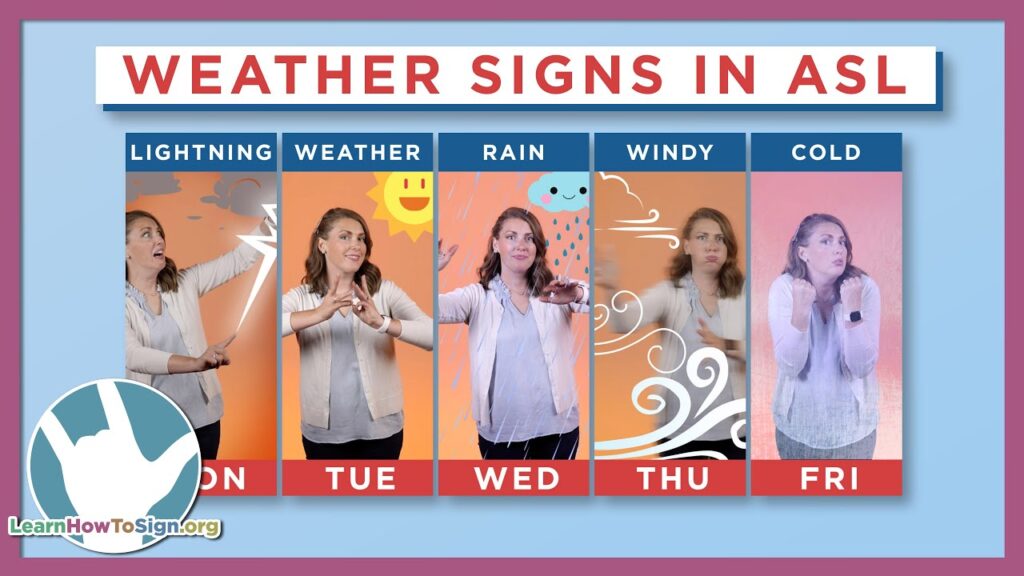
The sign “Weather” refers to atmospheric conditions such as rain, snow, sunshine, and wind. It is commonly used in daily conversations, especially when discussing the day’s climate or forecast. Understanding this sign is essential for effective communication about plans that may be affected by weather conditions.
[VIDEO_PLACEHOLDER]
Table of Contents
Forming the sign
- Handshape: Start with your dominant hand in a flat, open position with fingers extended.
- Location: Position your dominant hand in front of your chest, slightly above waist level.
- Movement: Move your hand back and forth in a gentle, wave-like motion. This movement mimics how clouds move across the sky.
- Non-manual signals: Raise your eyebrows slightly while signing to indicate a question or curiosity about the weather.
The sign visually represents weather patterns and is intuitive for many learners. By incorporating a smooth, gentle motion, it captures the essence of changing weather. The raised eyebrows can indicate curiosity, enhancing communication aspects when discussing the weather.
Using “Weather” in sentences
Here are a few examples of how to use “Weather” in sentences:
- Today’s weather is sunny. (Sign “Weather” followed by signs for “today” and “sunny.”)
- What will the weather be like tomorrow? (Use “weather” along with signs for “tomorrow” and expressions indicating questioning.)
- The weather was stormy last night. (Integrate “weather” with signs for “stormy” and “last night.”)
Signs related to “Weather”
Here are some related signs that can enhance your weather vocabulary:
- Sunny – Used to describe bright weather.
- Rain – Signifies rainy weather.
- Snow – Represents snowfall.
- Wind – Used to indicate windy conditions.
Regional variation
Like many signs, “Weather” can exhibit regional variations depending on the area. For instance, in some regions, the movement may be more exaggerated to express severe weather conditions, while in others, it may be more subtle. Observing signs in different communities can enrich your understanding and adaptability in using ASL.
FAQ
How do you sign different types of weather?
Each type of weather has its unique sign. For instance, “sunny” uses a different handshape and movement than “rain.” It’s helpful to learn these signs together to build your weather vocabulary.
Can I use “Weather” to ask about the forecast?
Yes, you can use “Weather” to inquire about the forecast. Pair it with facial expressions that indicate questioning for clarity.
Is there a sign for severe weather?
Yes, you can modify the sign for “Weather” to indicate severity by using more intense movements or adding signs for “storm” or “hurricane” to convey the specific conditions.
What’s the difference between “Weather” and “Sky”?
“Weather” focuses on atmospheric conditions, while “Sky” refers to the physical space overhead. They can be used together when discussing meteorological phenomena.
Are there expressions that go along with the sign?
Yes, facial expressions play a crucial role in conveying your emotions or concerns about the weather. For instance, frowning may indicate worry about a storm.
Practice ASL Signs
Use your camera to practice signs and get real-time AI feedback on your technique.
Free · No signup required