
See in Sign Language (ASL)
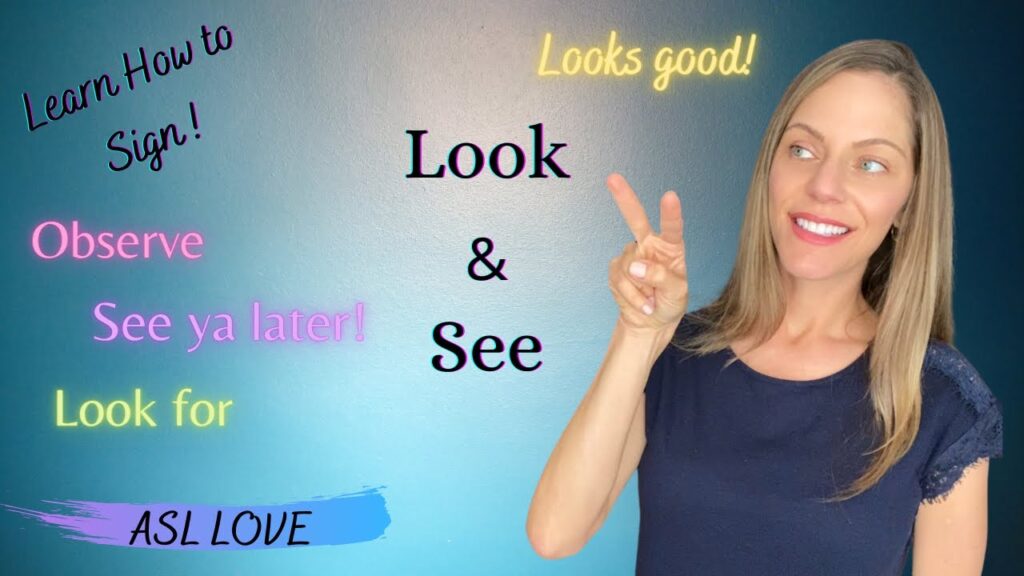
The sign “See” conveys the concept of visual perception and is used in various contexts to indicate that someone is viewing something or to suggest that one should pay attention. It’s commonly used in everyday conversations among Deaf individuals, often to engage others in visual experiences or discussions. The sign itself is straightforward and versatile, allowing for seamless integration into many sentences.
[VIDEO_PLACEHOLDER]
Table of Contents
How to Form the Sign “See”
- Handshape: Use the dominant hand in the “V” handshape, where the index and middle fingers are extended and separated, while the rest of the fingers are curled into the palm.
- Location: Position your hand near your eyes, typically at the level of the forehead or slightly lower.
- Movement: Move the “V” handshape forward from the face to indicate directing vision outward. You can also incorporate a slight gaze shift to emphasize the action.
- Non-manual signals: Maintain an attentive facial expression while signing. Raising your eyebrows slightly conveys interest and engagement.
The sign “See” is straightforward, with its primary focus on the action of looking or perceiving. The use of the “V” handshape in close proximity to the face emphasizes the act of seeing, making it easily recognizable in conversation.
Using “See” in Everyday Signing
The sign “See” can be used in numerous contexts. For instance, you might say, “I see you,” or “Do you see that?” It can also be part of more complex phrases, such as “I can see the sun,” or “See you later.” Additionally, it can be used in the imperative form, like “See this!” to draw attention to something specific.
Common Mistakes to Avoid
One common mistake is to forget the non-manual signals that add clarity to your signing. Ensure that your facial expressions reflect your intent—using raised eyebrows can indicate inquiry or excitement about what you’re seeing. Another mistake is using the sign too far from the face; remember that “See” should be communicated close to the eyes to maintain its meaning.
Signs Related to “See”
Watch – Signifying careful observation of something, often for a sustained period.
Look – A more general term indicating the act of directing your gaze at something.
Appear – Conveying the notion of something becoming visible or noticeable.
Show – To present something visually to another person.
Visual – Relating to sight or the ability to see.
A Learner’s Tip
When practicing the sign “See,” it can be helpful to incorporate it into daily conversations. Engage with others by describing things you see around you and use the sign frequently. This will not only help solidify your understanding but also make your signing flow more naturally in conversation.
Frequently Asked Questions
What is the difference between “See” and “Look”?
“See” generally refers to the act of perceiving with vision, while “Look” focuses on directing your gaze towards something specific. “Look” often implies intent, as in actively searching for or noticing something.
Can “See” be used in different tenses?
Yes, while “See” is primarily a present action, you can modify it with context or additional signs to indicate past or future actions. For example, you could use context clues or other signs to clarify the tense.
Is “See” used differently in various Deaf communities?
While the basic sign remains consistent, regional variations may exist in handshape or movement. It’s good practice to learn from local Deaf individuals to understand any nuances.
How can I improve my signing clarity when using “See”?
Focus on maintaining good eye contact and expressive facial cues. Practicing in front of a mirror can also help you refine your movements and ensure that they match your intended meaning.
Practice ASL Signs
Use your camera to practice signs and get real-time AI feedback on your technique.
Free · No signup required