
Right in Sign Language (ASL)
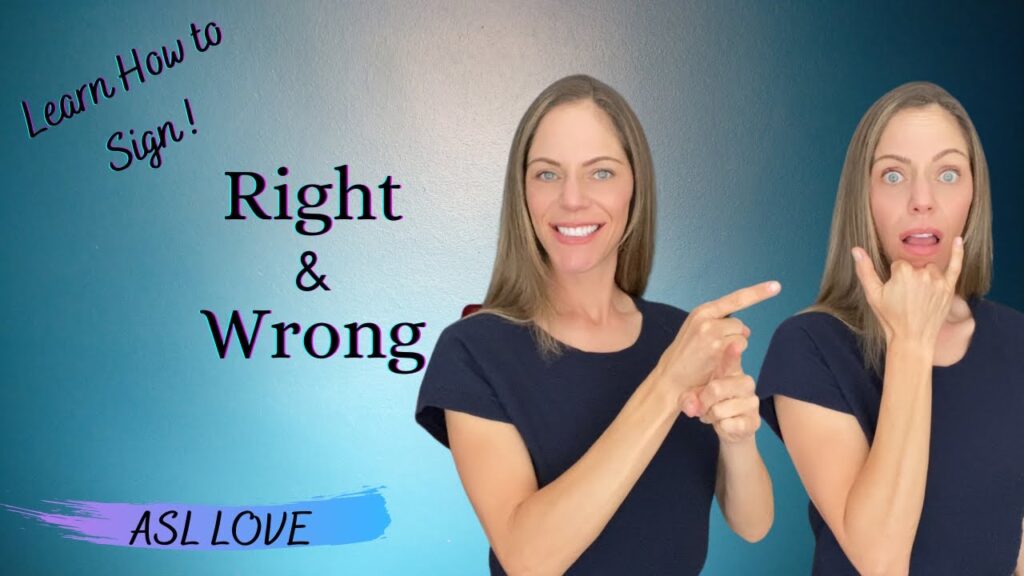
The sign “Right” can refer to the direction opposite of left, as well as to indicate correctness or something being proper. It is commonly used in daily conversations, whether giving directions or discussing opinions. Understanding the context in which “Right” is used is essential for clarity in communication.
[VIDEO_PLACEHOLDER]
Table of Contents
Forming the sign
- Handshape: The sign for “Right” is made using the dominant hand in a “B” handshape, where the fingers are extended and held together while the thumb is folded against the palm.
- Location: The hand is positioned in front of the body, typically at shoulder height.
- Movement: The hand moves laterally to the right side of the body, creating a clear gesture towards the right direction. This movement can vary slightly depending on the context in which it is used.
- Non-manual signals: A slight nod of the head can accompany the movement, emphasizing the directionality or correctness of what is being indicated.
Practicing this sign involves repeating the handshape and movement in various contexts, such as giving directions or confirming an answer. This will help embed the sign into your everyday vocabulary.
Using “Right” in sentences
In conversational ASL, “Right” can be integrated into various sentences. For example, when giving directions, you might say, “Go right at the corner.” Here, the sign is crucial for indicating the proper direction. Similarly, in discussions involving opinions, one could state, “That’s right!” to confirm correctness.
Another way to use “Right” is in contrast with “Left.” For instance, “Turn right, not left.” This reinforces understanding and clarity in communication.
Signs related to “Right”
Here are some signs that are often used in conjunction with or are conceptually related to “Right”:
- Left – The opposite direction of right.
- Correct – Indicates something is right or true.
- Wrong – The opposite of correct, often used in contrast with right.
- Direction – A broader concept that includes right, left, and other navigational signs.
- Yes – Can sometimes be paired with “Right” to emphasize agreement.
Common confusion with a similar sign
Deaf signers sometimes confuse “Right” with the sign for “Correct.” While both can indicate something true or proper, it’s essential to recognize the context in which each is used. “Right” often refers specifically to direction or correctness in immediate situations, while “Correct” is used to affirm an answer or statement in a more general sense.
FAQ
What does the sign “Right” mean?
The sign “Right” can indicate direction (as in right vs. left) or correctness, often used to affirm something as true or proper.
How do I practice the sign “Right” effectively?
To practice effectively, repeat the sign in different contexts. Try giving directions or discussing opinions to reinforce its use.
Can “Right” be used in questions?
Yes, “Right” can be used in questions, such as asking for confirmation: “Is that right?” accompanied by the appropriate facial expressions for questioning.
Are there regional variations of the sign “Right”?
While “Right” is generally consistent, some variants may exist depending on the region. It’s beneficial to observe and adapt to the local signing community.
How is “Right” different from “Right” in the sense of direction and correctness?
The context determines the meaning: “Right” as a direction is about navigation, while “Right” as correctness affirms a statement or answer.
Practice ASL Signs
Use your camera to practice signs and get real-time AI feedback on your technique.
Free · No signup required