
Queue in British Sign Language (BSL)

The sign for “queue” in BSL represents the concept of waiting in line, which is commonly encountered in everyday life, such as at shops, bus stops, or events. It’s a vital part of British culture, where queuing is respected, and this sign is frequently used in conversations among the Deaf community when discussing plans or events that involve waiting.
How to Sign “Queue”
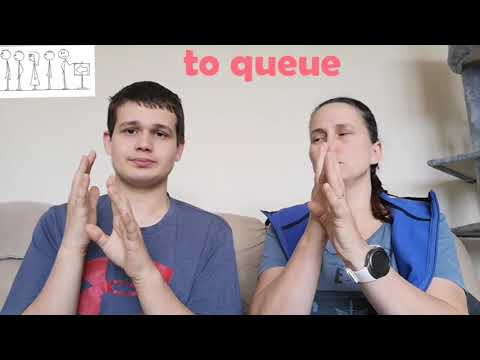
- Start with your dominant hand in a flat “B” handshape (fingertips together, palm facing down).
- Position your hand at the side of your body, around waist height.
- Move your hand forward in a straight line, as if representing people moving in a line.
- As you move your hand, use a slight forward lean with your upper body to show the action of queuing.
- Maintain an attentive facial expression, possibly raising your eyebrows to show interest in the queue.
Common Mistakes
- Forgetting to use the correct handshape, which can lead to confusion with other signs.
- Not incorporating non-manual features, such as facial expressions, which are crucial in conveying meaning.
- Moving the hand in an unclear or erratic manner, which can make the sign difficult to understand.
BSL vs ASL
In BSL, the sign for “queue” involves a flat hand moving forward to represent a line of people. In contrast, ASL uses a different handshape and motion to convey the same concept. This highlights the distinct differences between the two sign languages and their unique grammar and structure.
Related Signs
- Wait – A sign used to indicate the action of waiting.
- Line – Refers to a line or row of people or objects.
- Bus – The sign for bus, often used in the context of queuing for public transport.
- Shop – Related to queuing when shopping.
- Order – Often used in restaurants, where queuing can also happen.
Frequently Asked Questions
How can I use “queue” in a BSL sentence?
You can structure your sentence using topic-comment format, like “I queue for bus,” signing “I” as the topic and then “queue for bus” as the comment.
Are there regional variations for signing “queue” in the UK?
While the sign is generally consistent, some regions may have slight variations in movement or facial expressions based on local signing communities.
What is a similar sign to “queue”?
The sign for “wait” is similar and can be used in contexts where you are asking someone to wait in line.
What tips do you have for learning this sign?
Practice the movement in front of a mirror and focus on your facial expressions to ensure clarity in communication.
Can I use this sign in a group setting?
Yes, you can use the sign in group conversations, especially when discussing how to organise or manage a queue.
Is there a cultural significance to queuing in the Deaf community?
Yes, queuing is an important part of British culture, and understanding this concept is essential in social interactions within the Deaf community.
Practice This Sign
Try signing Queue In Bsl with your camera and get AI coaching on your handshape, movement, and location.
Free · No signup required