
Time in Sign Language (ASL)
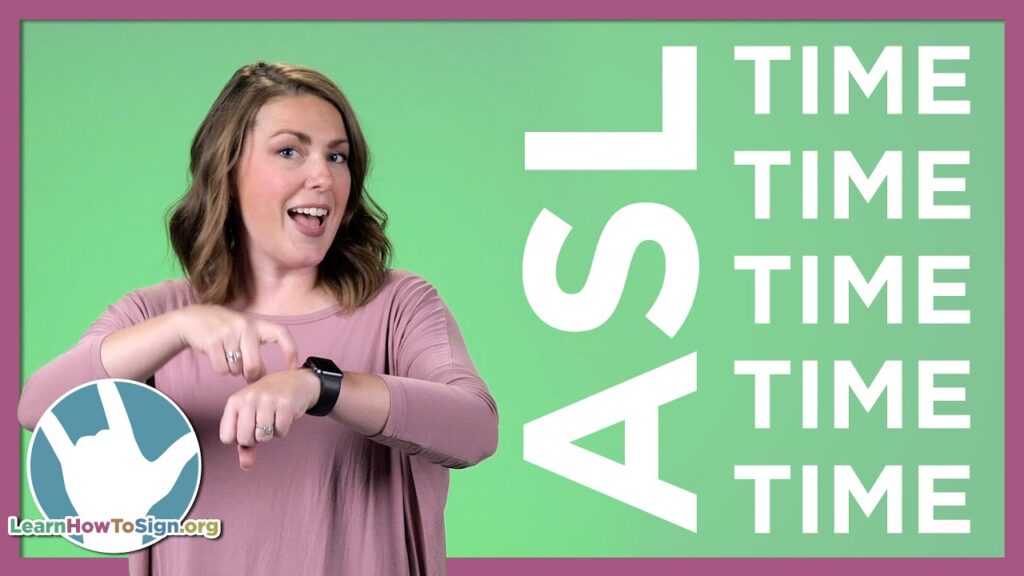
The sign for Time is a fundamental concept in American Sign Language, representing the idea of measuring, scheduling, or referring to specific moments. This sign is used frequently in daily conversations, whether discussing future plans, past events, or general time-related topics.
[VIDEO_PLACEHOLDER]
Table of Contents
Forming the sign
- Handshape: Start with a flat hand, palm facing down.
- Location: Position your dominant hand in front of your body, approximately at chest level.
- Movement: Move your dominant hand slightly from side to side, as if indicating the passing of time.
- Non-manual signals: Accompany the sign with a facial expression that corresponds to the context—raised eyebrows can indicate a question, while a neutral expression is suitable for statements.
The sign for Time is characterized by its fluid movement, mimicking the natural flow of time. It is essential to maintain a clear handshape and smooth motion to convey the concept effectively. Practicing in front of a mirror can help in refining your technique and ensuring clarity in your signing.
Using “Time” in sentences
In ASL, “Time” can be used in various contexts. For example:
– “What time is the meeting?” can be signed as “TIME MEETING WHAT?”.
– “I will see you at that time.” translates to “TIME THAT I SEE YOU, WILL.”
Understanding sentence structure in ASL, which often follows a different order than spoken English, is crucial for effective communication.
Signs related to “Time”
There are several related signs that expand on the concept of Time, including:
– Today: Refers to the current day or moment.
– Yesterday: Used to describe the day before today.
– Tomorrow: Indicates the day after the current one.
– Moment: A shorter time period.
– Always: Describes continuity over time.
Common confusion with a similar sign
Some learners may confuse the sign for Time with the sign for “Watch” (as in a wristwatch). While both signs involve the use of the hand in front of the body, the sign for Watch uses a different handshape and specific movement that mimics the action of checking the time on a watch. To avoid confusion, practice distinguishing the context in which you use each sign.
FAQ
What is the difference between Time and other time-related signs?
The sign for Time is more general, while signs like Yesterday, Today, and Tomorrow specify particular timeframes. Always pay attention to the context for accurate understanding.
Can I use Time in questions?
Yes, you can use Time in questions. Make sure to raise your eyebrows and maintain an inquisitive facial expression to indicate it is a question.
How do I incorporate Time into storytelling?
When telling a story, you can use Time to indicate when events happen. For example, if an event occurred in the past, sign Yesterday beforehand to set the context.
Is there a sign for specific times like 2:00 PM?
Yes, specific times can be fingerspelled or represented with numbers in combination with the sign for Time, such as signing “2” followed by “TIME.”
How can I improve my signing of Time?
Practice consistently in different contexts, and consider signing with a partner to get feedback. Utilizing visual aids can also help reinforce learning.
Practice ASL Signs
Use your camera to practice signs and get real-time AI feedback on your technique.
Free · No signup required