
Talk in Sign Language (ASL)
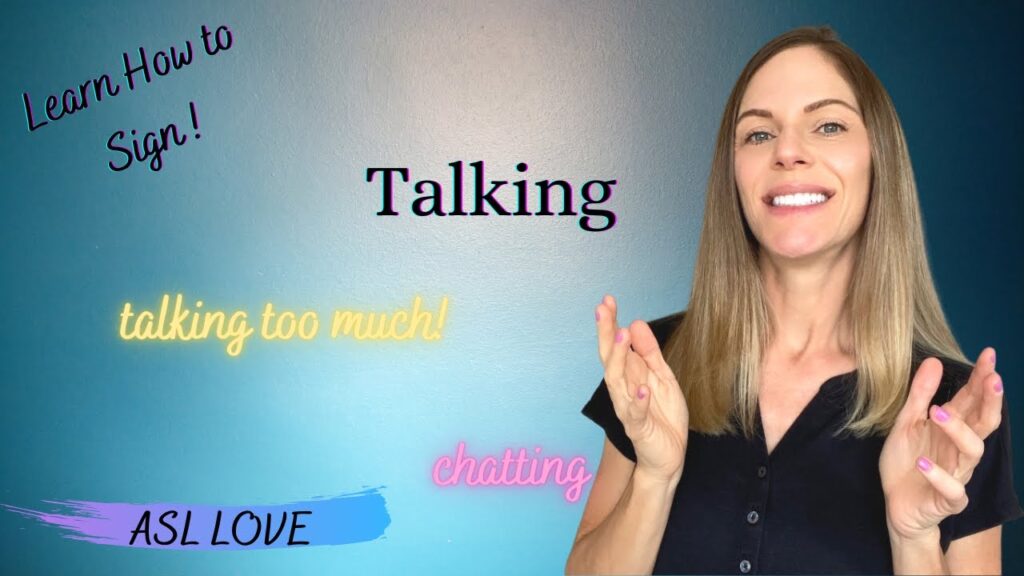
The sign “Talk” is used to express verbal communication or conversation between people. It captures the action of speaking or exchanging ideas through words. This sign is commonly used in everyday conversations among Deaf individuals, as well as in educational settings to discuss various topics related to communication.
[VIDEO_PLACEHOLDER]
Table of Contents
Forming the sign
- Handshape: Use a flat handshape with the dominant hand (the right hand for right-handed signers and the left for left-handed signers). The fingers should be extended together.
- Location: Position your dominant hand in front of your mouth, around the area where speech originates.
- Movement: Move your dominant hand away from your mouth slightly in a forward motion, as if you are projecting your voice.
- Non-manual signals: Facial expressions play a crucial role in conveying tone and intent. Use a friendly or engaging facial expression while signing “Talk” to enhance understanding.
This sign visually represents the action of speaking, capturing the essence of verbal interaction. By positioning the hand near the mouth and moving it forward, it illustrates the process of projecting words outward. Facial expressions further help convey the tone of the conversation, making the sign more expressive and engaging.
Showing tense, aspect & repetition
The sign “Talk” can be modified to indicate different tenses and aspects by adjusting the movement and facial expressions. To indicate past tense, you can perform the sign with a backward movement. For future tense, move the hand forward with more emphasis. Repetition can be shown by performing the sign multiple times quickly, indicating a lively discussion or continuous conversation. These variations help convey the timing and nature of the communication effectively.
“Talk” in everyday signing
You will encounter “Talk” in various contexts during casual conversations, meetings, and discussions. It can be paired with other signs to specify the subject matter, such as “Talk about school” or “Talk with friends.” You may also use the sign in questions like “Did you talk to them?” or statements such as “I want to talk.” This versatility allows “Talk” to fit seamlessly into daily interactions among Deaf individuals.
Common confusion with a similar sign
Many learners often confuse the sign “Talk” with the sign “Say,” which also involves communication but has a distinct handshape and movement. While “Talk” focuses on the act of verbal communication with an outward projection, “Say” typically involves a more direct representation of the words being spoken. Understanding the nuances of these signs will enhance clarity in conversations.
FAQ
Can “Talk” be used for written communication?
The sign “Talk” specifically refers to verbal communication, so it is not typically used to describe written communication. For writing, you can use the sign “Write.”
Is there a difference in how “Talk” is signed at different ages?
While the basic sign “Talk” remains consistent, younger signers may use it with more energetic movements, reflecting their excitement. Older signers might use a more subdued version, depending on their personal style.
How can I improve my signing of “Talk”?
To enhance your signing of “Talk,” practice in front of a mirror to observe your handshape, placement, and facial expressions. Engaging with fluent signers for feedback can also be beneficial.
What are some common phrases that use “Talk”?
Some common phrases include “Let’s talk,” “I want to talk,” or “Can we talk later?” These phrases utilize “Talk” to express desires or requests for conversation.
Practice ASL Signs
Use your camera to practice signs and get real-time AI feedback on your technique.
Free · No signup required