
Take in Sign Language (ASL)
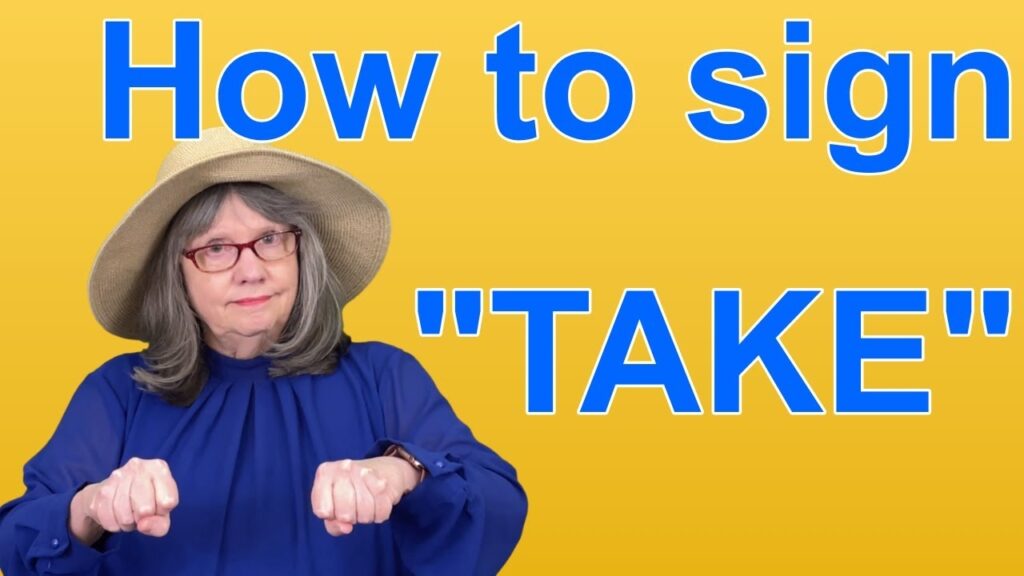
The sign “Take” is a commonly used verb in American Sign Language that conveys the action of grasping or receiving something. It can refer to physically taking an object, as well as metaphorically taking ideas or opportunities. Understanding how to properly form and use this sign is essential for effective communication in various contexts.
[VIDEO_PLACEHOLDER]
Table of Contents
Forming the sign
- Handshape: The dominant hand forms a flat “B” handshape, with the fingers extended together and the thumb tucked against the palm.
- Location: The sign is typically made in front of your body at chest level, close to your dominant side.
- Movement: The dominant hand moves toward the body, mimicking the motion of taking or grasping an object. The movement should be smooth and deliberate.
- Non-manual signals: Facial expressions can enhance the meaning of “Take.” For instance, a slight raising of the eyebrows can indicate a question, while a nod can affirm the action.
When signing “Take,” ensure that your movement is clear and intentional, as this will help convey your message effectively. Practice in front of a mirror can aid in refining the motion and ensuring proper formation.
Showing tense, aspect & repetition
In ASL, verbs often convey tense through context and movement rather than explicit markers. To indicate the past tense for “Take,” you can perform the sign with a backward movement, reflecting the action having already occurred. For future tense, a forward motion, extending away from your body, suggests an action yet to happen.
Aspect can be shown by modifying the speed or repetition of the sign. For example, a quick, repeated motion can imply multiple instances of taking, whereas a slow movement indicates a singular, deliberate action. Pay attention to the context of your conversation to determine how best to express the intended meaning.
“Take” in everyday signing
The versatility of “Take” allows it to fit seamlessly into various conversational contexts. Whether you’re asking someone to take an item, offering something for them to take, or discussing the concept of taking a break, this sign is fundamental. For example, you might sign, “Please take this book,” or “I want to take a moment to think.”
In casual conversations, “Take” can also be combined with other signs to convey more complex ideas, such as “take care” (combining “Take” with the sign for “care”) or “take it easy.” Understanding how “Take” interacts with other signs will enhance your fluency and clarity in ASL.
Common mistakes to avoid
One common mistake when signing “Take” is using an incorrect handshape. Ensure your hand remains in the flat “B” shape throughout the movement. Additionally, misplacing the sign, either too far from your body or at an inappropriate height, can lead to confusion. It’s essential to keep the sign at chest level and ensure the movement is directed towards your body.
Another frequent error is neglecting facial expressions. Remember, non-manual signals play a crucial role in conveying the full meaning of the sign. Practice incorporating facial expressions that match the context of your signing.
Signs related to “Take”
Here are some related signs that can complement your use of “Take”:
- Give: The act of offering something to someone else.
- Receive: The action of accepting something offered or given.
- Put: To place something down, the opposite of taking.
- Grab: A more forceful or quick action of taking something.
- Share: To take something and give a part of it to someone else.
A learner’s tip
When learning the sign “Take,” practice in different contexts to build your comfort and fluency. Try using it in sentences, both in isolation and as part of longer phrases. Engaging in small conversations with Deaf friends or peers will also help you to naturally incorporate the sign into your vocabulary. Additionally, watching videos or live signing can provide valuable insights into proper usage and nuances.
FAQ
What is the difference between “Take” and “Give”?
“Take” refers to the action of grasping or receiving something, while “Give” involves offering or transferring something to someone else. These signs are often used in conjunction to describe exchanges.
Can “Take” be used in different contexts?
Yes, “Take” is versatile and can be used in various contexts, such as taking an object, taking a break, or taking an opportunity. The context and accompanying signs will clarify its specific meaning.
How do I indicate the past tense of “Take”?
To indicate the past tense of “Take,” you can move your hand backward from where you started, suggesting that the action has already occurred.
Are there regional variations of the sign “Take”?
Yes, there can be regional variations in how “Take” is signed. Observing native signers from different areas can help identify these differences.
What should I focus on to improve my signing of “Take”?
Focus on the clarity of your handshape, the appropriateness of your movements, and the incorporation of facial expressions to convey the correct meaning and context.
Practice ASL Signs
Use your camera to practice signs and get real-time AI feedback on your technique.
Free · No signup required