
Stamp in Sign Language (ASL)
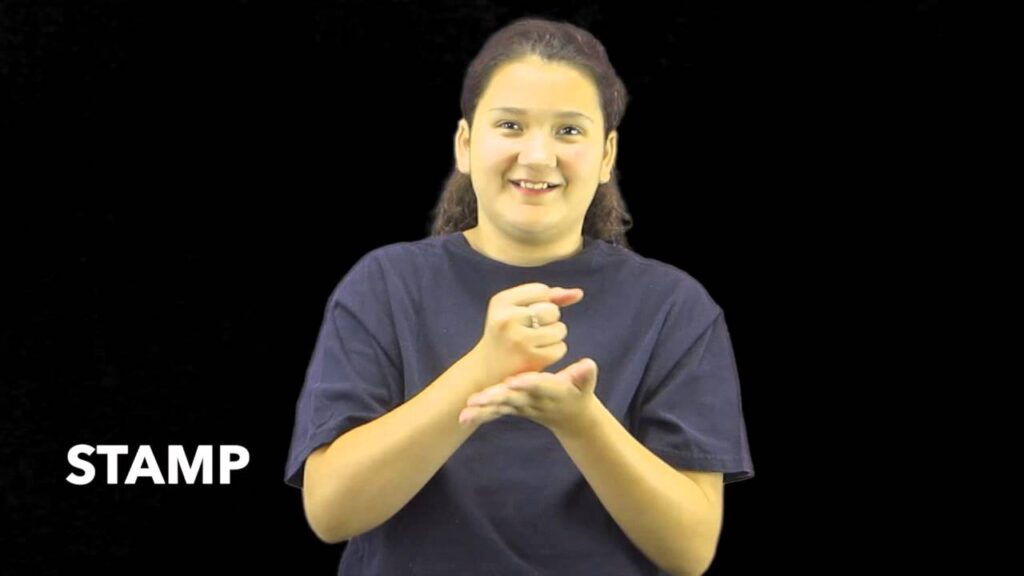
The sign “Stamp” refers to the action of marking or impressing a surface, often used in the context of mailing letters or documents. It represents the act of applying a postage stamp or creating an imprint. This sign is commonly used in discussions about sending mail, collecting stamps, or performing tasks that involve stamping actions.
[VIDEO_PLACEHOLDER]
Table of Contents
How to Form the Sign for Stamp
- Handshape: Use the flat, open handshape with your dominant hand. Your fingers should be extended and together, resembling a flat surface.
- Location: Position your dominant hand in front of your non-dominant hand, which can be flat or held in a fist, representing a surface to be stamped.
- Movement: Move your dominant hand down onto the non-dominant hand, mimicking the action of stamping. The movement should be quick and decisive, emphasizing the action.
- Non-manual signals: Maintain a neutral facial expression during the action, but you can raise your eyebrows slightly as you perform the stamp to indicate emphasis or importance.
This sign effectively conveys the action of stamping, whether it’s applying a postage stamp or leaving an imprint on paper. The movement emphasizes the action, making it clear and straightforward for the viewer to understand.
Using “Stamp” in Everyday Signing
In daily conversations, you might use “Stamp” when discussing various topics related to mailing, such as: “I need to stamp this letter before sending it,” or “Do you collect stamps?” Here are a few examples:
- “I forgot to stamp the envelope.” (use the sign as you describe the action)
- “Stamp collecting is a fun hobby.” (you might use the sign to emphasize the concept)
- “Can you help me stamp all these invitations?” (sign alongside the gesture of handing over invitations)
Signs Related to “Stamp”
Here are some signs that are related to “Stamp” and might be useful in various contexts:
- Mail – Referring to the act of sending letters and packages.
- Collect – Often used in conjunction with stamp collecting.
- Envelope – The item that typically requires a stamp.
- Letter – The correspondence that is often stamped before mailing.
- Postage – The fee associated with sending mail, often indicated by the stamp.
Common Confusion with a Similar Sign
One common point of confusion with the sign “Stamp” is its similarity to the sign for “Hit.” Both involve a downward motion, but the context differentiates them. When signing “Stamp,” the hand moves down onto another hand representing the surface, while “Hit” conveys a more aggressive action, often without the presence of a second hand. To avoid confusion, be sure to clearly establish the context when using these signs.
FAQ
What does the sign “Stamp” look like?
The sign “Stamp” features a flat dominant hand moving down onto a non-dominant hand, which can be flat or in a fist, representing the action of stamping.
Is “Stamp” used in different contexts?
Yes, “Stamp” can refer to postage, as well as the act of stamping documents or cards in various settings like crafting or art.
How can I practice the sign “Stamp”?
To practice “Stamp,” simulate the action of stamping on various surfaces and incorporate it into conversations about mailing or crafting.
Can you use “Stamp” with other signs?
Absolutely! You can combine “Stamp” with signs for “mail,” “envelope,” and many others to provide context and clarity in your communication.
Practice ASL Signs
Use your camera to practice signs and get real-time AI feedback on your technique.
Free · No signup required