
Line in Sign Language (ASL)
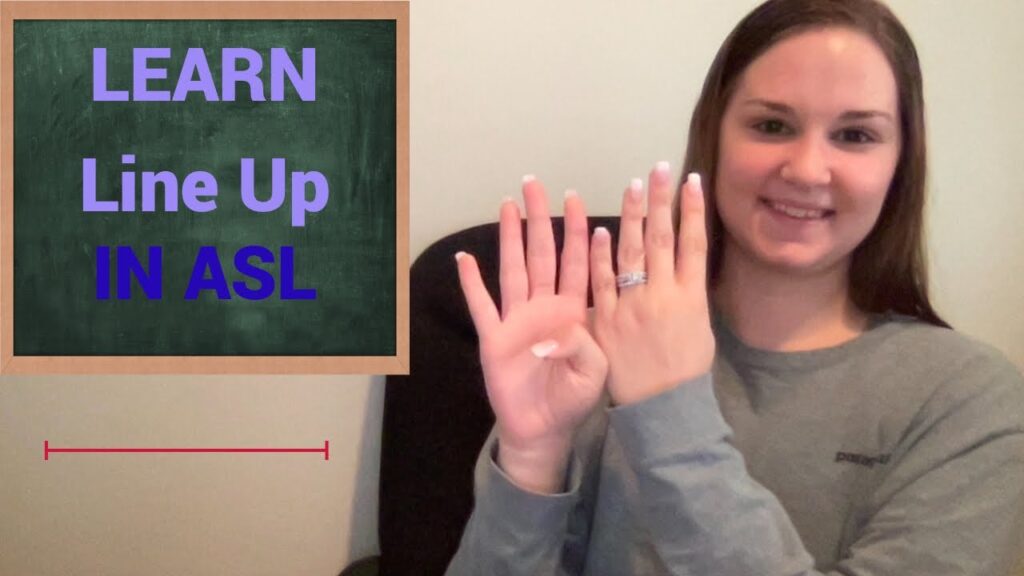
The sign “Line” is typically used to represent a straight or continuous mark, something that connects two points, or a boundary. It can refer to a physical line, like a line you draw, or abstract concepts, such as a line of thought or a line of communication. This sign is versatile and can be adapted to various contexts, making it a valuable addition to your ASL vocabulary.
[VIDEO_PLACEHOLDER]
Table of Contents
Forming the sign
- Handshape: Use your dominant hand in a flat ‘B’ handshape, where fingers are extended together and the thumb is held against the palm.
- Location: Position your hand in front of your body, roughly at chest height.
- Movement: Move your hand horizontally from left to right, or vice versa, to depict the concept of a line being drawn or extended.
- Non-manual signals: Maintain a neutral facial expression to convey a straightforward meaning. However, you can raise your eyebrows slightly to indicate emphasis or question the line’s significance.
The sign is often used in contexts involving directions, drawing, or explaining concepts. By moving your hand from one side to the other, you visually represent the continuity of a line, making it easier for the viewer to understand the concept you’re conveying.
Using “Line” in sentences
In ASL, context is key. Here are a few examples of how to use “Line” in different sentences:
- To express that you are drawing a line, you can sign: “I am drawing a line” (use “draw” before the sign for “line”).
- When discussing waiting in line, you might sign: “I waited in line for tickets” (placing the sign for “wait” before “line”).
- To talk about the line of communication, you can sign: “We keep the line open” (using “keep” and “open” with “line”).
Signs related to “Line”
There are several signs that share a thematic connection with “Line”:
- Draw – The action of marking or creating a line on a surface.
- Wait – Often used in conjunction with “line” when discussing standing in line.
- Boundary – A line that marks the limits of an area.
- Communication – Referring to lines of communication or connection between people.
Regional variation
While the sign for “Line” is generally consistent across different regions, some Deaf communities may have specific variations in speed or hand orientation. In some areas, the movement may be more pronounced, emphasizing the length of the line, while other regions may maintain a subtler motion. Observing local signing practices can enhance your understanding and fluency in ASL.
FAQ
What contexts can I use the sign “Line”?
The sign “Line” can be used in various contexts, including drawing, waiting in line, discussing boundaries, or in conversations about communication.
Can “Line” also refer to abstract concepts?
Yes, “Line” can refer to abstract ideas like a line of reasoning, line of thought, or lines in written communication.
Is there a different sign for “line” when discussing a line of people?
The sign remains the same, but you can add contextual signs, such as “wait” or “group,” to clarify you are talking about a line of people.
How can I emphasize the “Line” sign?
You can emphasize the sign by using stronger movements or adding non-manual signals, like raised eyebrows, to express importance or question.
Practice ASL Signs
Use your camera to practice signs and get real-time AI feedback on your technique.
Free · No signup required