
Blame in Sign Language (ASL)
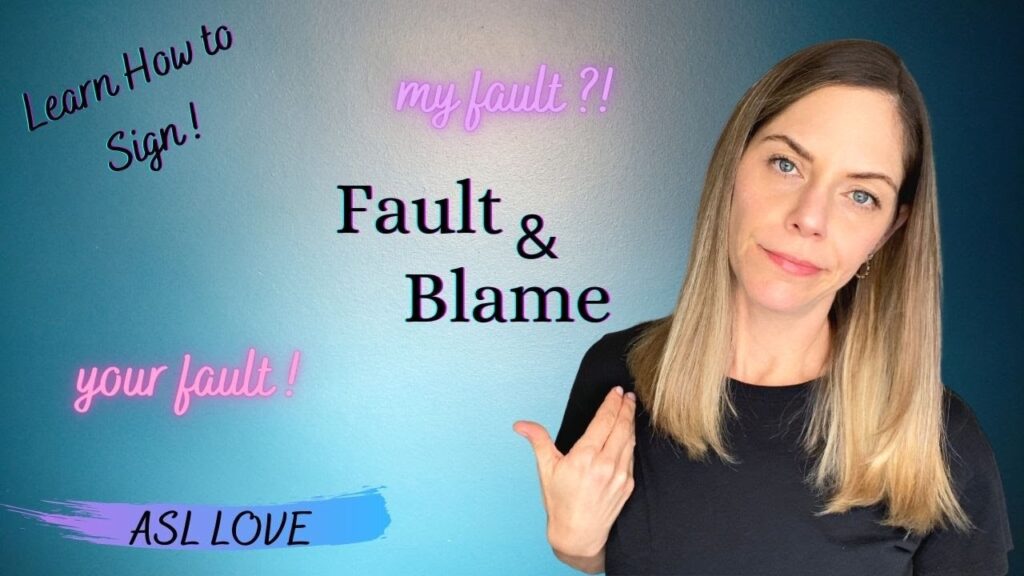
Blame is a versatile sign used to convey the act of holding someone responsible for a mistake or wrongdoing. It is often employed in discussions about accountability, whether in personal relationships, workplace dynamics, or general conversations about fairness. Understanding how to sign “blame” can enhance communication in various contexts, particularly when discussing sensitive topics.
[VIDEO_PLACEHOLDER]
Table of Contents
Forming the sign
- Handshape: The dominant hand forms a flat “B” handshape.
- Location: Start with your dominant hand near your chest, slightly away from your body.
- Movement: Move the hand outward, away from your body, while simultaneously bending your elbow slightly, as if pushing away a person or idea.
- Non-manual signals: Use a serious facial expression to emphasize the gravity of the act of blaming.
This sign encapsulates the essence of blame, where the outward movement signifies distancing oneself from the responsibility. The facial expression adds an emotional layer, indicating the seriousness or weight of the statement being made. Proper execution of these elements will help ensure clarity in your communication.
Using “Blame” in sentences
In everyday conversation, you might say: “I don’t want to blame you for the mistake,” signed as “I NOT WANT BLAME YOU MISTAKE.” Another example could be, “He always blames others,” which would be signed as “HE ALWAYS BLAME OTHERS.” The structure used in these sentences demonstrates how “blame” fits naturally into various contexts, showing causation and accountability.
Signs related to “Blame”
Understanding related signs can deepen your comprehension and usage of “blame.” Here are a few that might be useful:
- Accuse – to charge someone with a wrongdoing.
- Responsibility – the state of being accountable.
- Forgive – to stop feeling angry or resentful towards someone for an offense.
- Criticize – to indicate disapproval of someone’s actions or decisions.
Common confusion with a similar sign
Many learners often confuse “blame” with “accuse.” While both signs involve placing responsibility on someone, “accuse” specifically implies a formal or legal charge against someone. In contrast, “blame” is broader and can be used in everyday situations without the need for formal action. Pay attention to context and facial expressions to differentiate between these two signs.
FAQ
What is the difference between “blame” and “criticize”?
While both involve expressing disapproval, “blame” focuses more on assigning responsibility, whereas “criticize” can involve feedback and evaluation of actions or decisions without necessarily assigning fault.
Can “blame” be used in a positive context?
Yes, “blame” can sometimes refer to understanding or acknowledging a mistake in a constructive way, such as discussing how to improve in the future without placing negative judgment on the person involved.
How can I practice signing “blame”?
To practice, try using “blame” in various sentences about personal experiences, role-play scenarios, or even with a partner to enhance your fluency and accuracy.
Is there a specific facial expression I should use when signing “blame”?
A serious or concerned expression enhances the weight of the sign, indicating that the act of blaming is significant or carries emotional impact.
Practice ASL Signs
Use your camera to practice signs and get real-time AI feedback on your technique.
Free · No signup required