
Add in Sign Language (ASL)
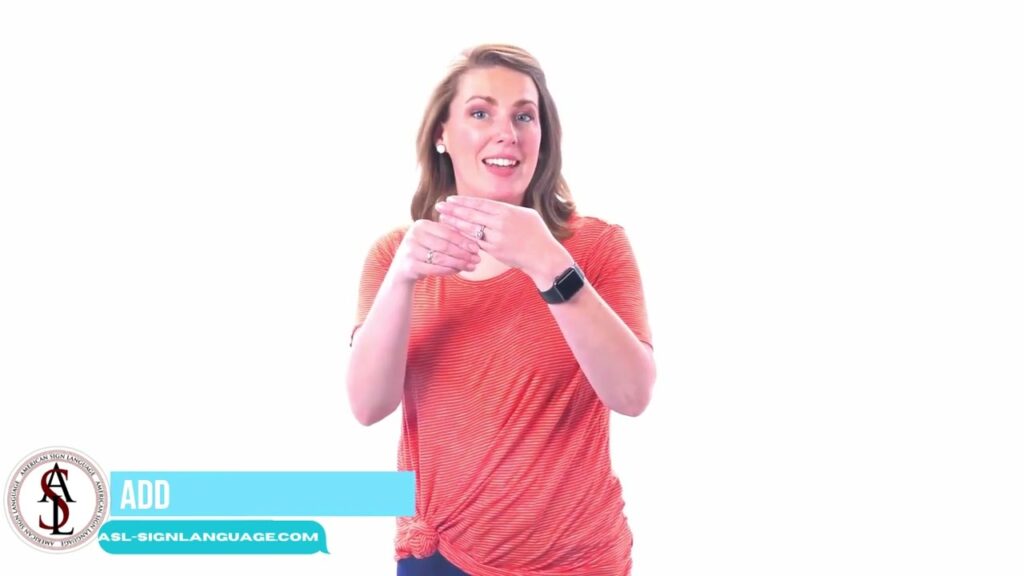
The sign “Add” represents the action of combining or increasing quantities or elements. It is commonly used in contexts like mathematics, cooking, or when discussing lists or tasks. The sign effectively conveys the idea of augmentation and is a fundamental concept in everyday communication.
[VIDEO_PLACEHOLDER]
Table of Contents
Forming the sign
- Handshape: Use your dominant hand in a flat ‘B’ shape, where the fingers are extended and together, and the palm faces down.
- Location: Position your dominant hand in front of your body, at about waist level.
- Movement: Start with your hand in the ‘B’ shape and move it slightly forward and upward, as if you are adding something to a pile.
- Non-manual signals: Adding a slight nod of the head during the movement can help emphasize the action of adding.
This sign effectively illustrates the concept of addition by mimicking the act of placing one item on top of another. The movement of your hand can vary in speed and intensity, depending on the context and what you are trying to convey.
Showing tense, aspect & repetition
In ASL, the sign “Add” can be modified to convey different tenses and aspects. To indicate the past, you can start the sign further back in relation to your body. For the future, begin the sign slightly in front of your body. To show repetitive addition, you can use a continuous motion, keeping your hand moving in the upward direction, which signifies ongoing addition. This flexibility allows for greater clarity in communication, particularly in mathematical or instructional contexts.
“Add” in everyday signing
In everyday conversations, “Add” can be used in various scenarios such as discussing grocery lists, calculating expenses, or even during games where points are added. For example, if you say, “I will add milk to the shopping list,” you would sign “I” + “ADD” + “milk” + “to” + “shopping list.” The sign is also useful in classroom settings when teachers explain addition concepts to students.
Common confusion with a similar sign
Often, learners confuse “Add” with the sign for “Plus,” which is a different sign used primarily in mathematical contexts. While “Add” conveys the action of combining items or quantities, “Plus” specifically refers to the mathematical operation of addition. Being mindful of the context and the specific action you want to express can help avoid this mix-up.
FAQ
Can “Add” be used in mathematical contexts?
Yes, “Add” is frequently used in mathematical conversations, especially when teaching or discussing addition.
How can I emphasize the action of adding?
You can use a quicker or more vigorous movement and include non-manual signals like nodding your head to emphasize the action.
Is there a different sign for “Add” in different regions?
While the sign for “Add” is generally consistent, regional variations may exist. It’s good to learn from local users to familiarize yourself with any differences.
Can I use “Add” in a more abstract sense?
Absolutely! “Add” can also be used in abstract contexts, such as adding ideas to a discussion or contributions in a group project.
What other signs are related to “Add”?
Related signs include Plus (specifically for mathematical addition), Combine (to merge items), and List (for grouping items).
Practice ASL Signs
Use your camera to practice signs and get real-time AI feedback on your technique.
Free · No signup required